How to Install Professional Auto Modification Smart Film on Car Windows Step by Step
Learn more >


Glass has become one of the defining elements of modern architecture. Walk into a newly designed office, a luxury hotel, a medical center, or even a high-end residential project, and you will notice the same trend: larger glass partitions, more open interiors, and fewer traditional walls.
Architects appreciate glass because it improves natural light, creates a sense of openness, and gives interiors a cleaner and more contemporary appearance. But the more transparent a space becomes, the harder it is to manage privacy in a practical way.
For years, designers relied on curtains, blinds, etched glass, or permanent frosted glazing to solve this problem. Those solutions still exist, but they often feel outdated in modern commercial environments where flexibility and minimalist aesthetics matter just as much as functionality.
This is one of the key reasons Intelligent Smart Film has become increasingly popular across the architectural and smart building industries.
Unlike conventional privacy materials, Intelligent Smart Film allows glass to switch electronically between transparent and frosted states within seconds. Instead of physically covering glass, the glass itself becomes dynamic and controllable.
In commercial construction, this technology is now widely used in office meeting rooms, hotel bathroom partitions, healthcare spaces, luxury residences, retail storefronts, and smart home systems. More importantly, it is gradually moving beyond the category of “specialty glass products” and becoming part of a broader intelligent building strategy.
Understanding how Intelligent Smart Film works requires more than a simple explanation of “transparent when powered, frosted when off.” The real value of the technology lies in the way it combines optical control, space efficiency, architectural aesthetics, and intelligent integration into one system.

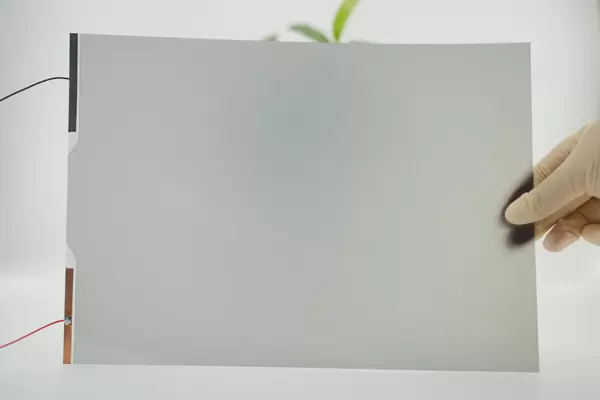
Intelligent Smart Film is an electronically switchable film designed to control the transparency of glass surfaces.
The product is commonly referred to by several industry terms, including:
●PDLC Smart Film
●Switchable Smart Film
●Smart Privacy Film
●Electric Privacy Film
● Self-Adhesive Smart Film
Although the names vary slightly, most commercial systems are based on the same core technology: PDLC, or Polymer Dispersed Liquid Crystal.
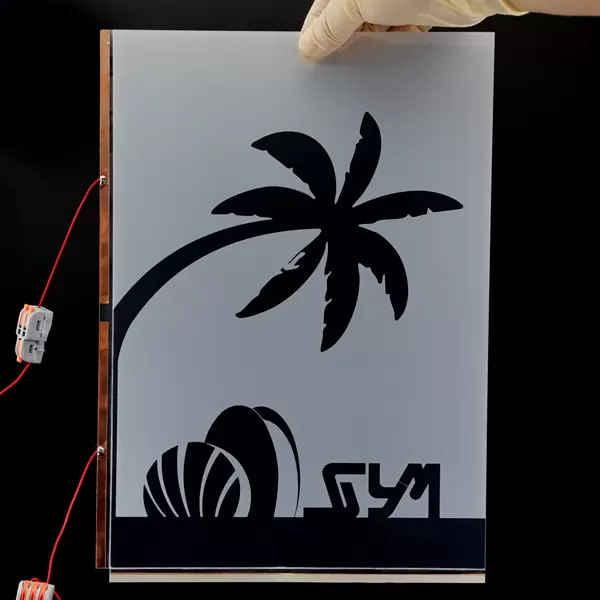
The film is installed onto glass and connected to a power supply. When electrical current is applied, the glass becomes transparent. When the power is removed, the glass turns opaque or frosted.
The switching process happens almost instantly, allowing spaces to transition between openness and privacy in real time.
Unlike traditional decorative window films, Intelligent Smart Film is not intended purely for appearance. It functions as an active optical control material capable of changing the behavior of glass itself.
That difference is important because modern architectural projects increasingly demand spaces that can serve multiple purposes throughout the day.
A conference room may need to feel open during normal office hours but become private during executive meetings. A hospital observation window may require visibility for medical staff while still protecting patient privacy. A hotel bathroom may need to create a spacious visual experience without permanently exposing the interior.
Smart Film allows these transitions to happen without curtains, blinds, or mechanical shading systems.
To understand why Intelligent Smart Film has gained momentum, it helps to look at how commercial interiors have changed over the last decade.
Older office environments relied heavily on enclosed rooms and solid walls. Privacy was built into the structure itself. Today, the design philosophy is very different.
Open-plan layouts, transparent partitions, and daylight-focused architecture have become standard in many industries. Companies want interiors that feel collaborative, flexible, and visually connected.
At the same time, privacy still matters.
This creates a design contradiction. Spaces are expected to feel open without actually remaining exposed all the time.
Traditional solutions struggle to solve this balance effectively.
Curtains occupy physical space and interrupt clean architectural lines. Blinds introduce moving components that eventually wear out or require maintenance. Permanent frosted glass eliminates flexibility because the transparency level never changes.
In many modern projects, these older approaches also conflict with the minimalist design language architects are trying to achieve.
Smart Film addresses the problem differently. Instead of adding another object to the glass, it transforms the glass itself into an intelligent surface capable of adapting to different situations.
That shift from “covering glass” to “controlling glass” is one of the main reasons the technology has become attractive in commercial architecture.
The operating principle behind Intelligent Smart Film is based on light scattering and liquid crystal alignment.
Inside the film is a specialized PDLC layer containing microscopic liquid crystal droplets dispersed within a polymer matrix. These liquid crystal particles respond to an electrical current.
Their alignment determines whether light passes directly through the glass or becomes scattered.
When the film is not receiving electrical power, the liquid crystal molecules remain randomly arranged.
Because the particles point in different directions, incoming light becomes diffused as it passes through the film layer.
This scattered light prevents clear visibility through the glass, causing the surface to appear frosted or opaque.
Even though the glass no longer allows clear viewing, natural light can still pass through the space. This is one reason smart privacy film is often preferred over blackout curtains in commercial environments.
The room maintains brightness while gaining privacy.
In office environments, this effect is commonly used for:
●Conference room privacy
●Executive office partitions
●Interview rooms
●Training areas
In healthcare projects, it is often applied in:
●ICU observation windows
●Patient consultation rooms
●Diagnostic spaces
●Medical treatment partitions
When voltage is applied, the liquid crystal particles align in a uniform direction.
Once aligned, light can pass through the film with much less scattering. The glass then becomes transparent.
The switching process is extremely fast and usually occurs within milliseconds.
From a technical perspective, the transparency level depends on several factors, including:
●Quality of the PDLC layer
●ITO conductive coating performance
●Film thickness
●Manufacturing consistency
●Electrical stability
Higher-quality Intelligent Smart Film systems generally provide:
●Better transparency
●Lower haze
●Faster switching speed
●Improved color neutrality
●Longer operational lifespan
This is one reason why commercial buyers increasingly focus on optical performance rather than simply comparing price.
Although Smart Film appears thin and simple from the outside, it is actually a multilayer optical and conductive system.
A typical Intelligent Smart Film structure includes several functional components working together.
| Layer | Function |
|---|---|
| PET Protective Layer | Protects the film surface and improves durability |
| ITO Conductive Layer | Transfers electrical current evenly across the film |
| PDLC Liquid Crystal Layer | Controls light transmission behavior |
| ITO Conductive Layer | Transfers electrical current evenly across the film |
| Adhesive Layer | Bonds the film to the glass surface |
Each layer affects overall performance.
For example, the quality of the ITO conductive coating directly impacts transparency consistency across large glass panels. Inferior conductive coatings can lead to uneven switching or visible gradient effects.
Similarly, edge sealing quality plays a major role in long-term durability. Moisture intrusion is one of the most common causes of PDLC film degradation over time.
This becomes especially important in humid environments such as:
●Hotel bathrooms
●Spa facilities
●Swimming pool areas
●Coastal construction projects
Experienced smart film manufacturers usually place significant emphasis on sealing technology and electrical stability because these factors strongly influence product lifespan.
The growth of the smart film industry is not simply driven by technology trends. It is closely connected to larger changes happening across architecture and interior design.
One major factor is the expansion of glass-based architecture.
Modern buildings increasingly rely on transparent materials to create openness, improve daylight penetration, and reduce the visual heaviness of interior spaces. But large glass surfaces naturally create visibility issues.
Smart Film allows architects to keep the openness of glass while adding controllable privacy when needed.
Another reason is the rise of intelligent buildings.
Commercial buildings today are increasingly integrated with automation systems that control lighting, climate, access, and audiovisual equipment. Intelligent Smart Film fits naturally into this ecosystem because it can integrate with:
●Wall switches
●Remote control systems
●Smart home platforms
●Voice control systems
●Central building automation systems
In many modern office projects, conference room smart glass systems are now connected directly to scheduling or meeting room control systems.
When a meeting begins, the glass automatically switches to privacy mode.
This level of integration is difficult to achieve with traditional curtains or blinds.
Office interiors remain one of the largest application areas for Intelligent Smart Film.
Over the last decade, commercial office design has shifted heavily toward glass partition systems. Companies want interiors that feel more collaborative and less isolated.
However, fully transparent offices create practical problems.
Employees may feel constantly exposed. Confidential discussions become difficult. Video meetings and presentations often require temporary visual separation.
Traditional blinds solve some of these issues, but create a cluttered appearance that many modern offices try to avoid.
Smart Film provides a cleaner solution because the glass itself becomes the privacy control system.
In many projects, switchable smart film is used for:
●Boardrooms
●Executive offices
●HR interview rooms
●Financial consulting areas
●Legal meeting spaces
●Co-working environments
Because the technology responds instantly, the same space can function as both an open collaborative area and a private room depending on operational needs.
For commercial designers, that flexibility is increasingly valuable as office layouts become more multifunctional.
Hotels were among the earliest adopters of smart privacy glass technology.
Luxury hospitality design often focuses on creating larger and more visually open rooms. Glass bathroom partitions became popular because they make guest rooms appear more spacious and modern.
But transparent bathroom layouts also introduce obvious privacy concerns.
Instead of relying on curtains or sliding panels, many hotels now use PDLC Smart Film to create switchable bathroom privacy glass.
The guest can control transparency instantly through a wall switch or smart room control panel.
Beyond aesthetics, hotels also appreciate the operational advantages:
●Fewer moving mechanical parts
●Reduced curtain maintenance
●Easier cleaning
●Better moisture resistance
●Improved luxury perception
In premium hospitality projects, Smart Film is often viewed as both a functional solution and a design feature that enhances the guest experience.
Medical spaces require a unique balance between visibility and patient privacy.
Traditional fabric curtains used in hospitals can create hygiene concerns because they collect dust, bacteria, and contaminants over time.
Intelligent Smart Film provides a cleaner alternative for many healthcare environments.
Common applications include:
●ICU observation windows
●Consultation rooms
●Operating room observation panels
●Medical testing spaces
●Patient treatment areas
Medical staff can maintain visibility when needed while instantly protecting patient privacy during examinations or treatment procedures.
Another advantage is cleaning efficiency. Since the film is integrated onto glass rather than using hanging fabric systems, surfaces are easier to disinfect and maintain.
This is one reason healthcare architects increasingly consider smart privacy film during modern hospital planning.
Retail environments use Intelligent Smart Film somewhat differently from offices or hospitals.
In many commercial storefronts, the film functions as both a privacy material and a projection surface.
When switched to opaque mode, the glass can display projected advertisements, brand visuals, or interactive media content. When transparent, the same glass becomes a standard storefront window again.
This dual-purpose capability is especially useful in:
●Luxury retail stores
●Automotive showrooms
●Technology exhibitions
●Experience centers
●Shopping mall displays
As digital retail environments continue evolving, projection-compatible smart glass systems are becoming more common in high-end commercial spaces.
One of the most common questions from buyers is the difference between Smart Film and Smart Glass.
Although both use PDLC technology, their installation methods are different.
| Smart Film | Smart Glass |
|---|---|
| Installed onto existing glass | Manufactured inside laminated glass |
| Suitable for retrofit projects | Typically planned during construction |
| Available in self-adhesive versions | Requires glass fabrication |
| Faster installation process | Higher structural integration |
| Lower renovation cost | More seamless, integrated appearance |
Self-adhesive Smart Film is especially attractive for retrofit projects because existing glazing systems can remain in place.
For example, many office renovation projects already have tempered glass partitions installed. Replacing all the glass would be expensive and disruptive.
Applying self-adhesive PDLC film directly onto the existing glass is often faster and more cost-effective.
Smart Glass, meanwhile, is more common in large architectural projects where the glazing system is designed from the beginning of construction.
Yes, and this is one of its strongest commercial advantages.
Retrofitting existing glass is one of the main reasons many architects and contractors choose self-adhesive smart film solutions.
The film can typically be applied to:
●Existing office partitions
●Tempered glass walls
●Glass entrance systems
●Retail storefront windows
●Residential glazing panels
However, successful installation depends heavily on preparation quality.
Large-format installations require attention to:
●Surface cleanliness
●Electrical routing
●Alignment accuracy
●Edge sealing
●Power supply stability
Improper installation can lead to visible defects such as bubbles, uneven transparency, or electrical inconsistency.
For this reason, most large commercial projects rely on trained installation teams familiar with PDLC film systems.
Power consumption is usually lower than many first-time buyers expect.
Most PDLC Smart Film systems only consume power while in transparent mode. When switched to opaque mode, continuous electricity is generally not required.
In commercial buildings, the electrical load is relatively moderate compared with HVAC systems, lighting infrastructure, or motorized shading equipment.
The more important issue is stable voltage delivery.
High-quality power transformers and reliable electrical design help ensure:
In professional commercial installations, electrical reliability matters far more than minimizing power usage by a small margin.
Product lifespan depends on several factors, including manufacturing quality, environmental conditions, and installation standards.
Commercial-grade PDLC Smart Film systems are typically designed for long-term operation and can often achieve service lives exceeding ten years under proper conditions.
Several factors strongly influence durability:
●UV exposure
●Humidity
●Edge sealing quality
●Electrical stability
●Installation workmanship
●Temperature fluctuations
Poor edge protection is one of the most common causes of long-term failure because moisture can gradually penetrate the conductive layers.
This is why experienced smart film suppliers usually focus heavily on sealing technology and quality control rather than only advertising transparency figures.
The role of Intelligent Smart Film is continuing to expand as buildings become more connected and adaptive.
In the past, smart film was often treated as a specialty architectural feature. Today, it is increasingly integrated into broader intelligent building systems.
Future development trends are likely to include:
●Improved optical clarity
●Lower haze levels
●Larger seamless installations
●Better energy efficiency
●Voice-controlled transparency
●IoT integration
●Smart projection compatibility
●AI-driven environmental control systems
As architecture continues shifting toward multifunctional and responsive environments, glass surfaces themselves are becoming more interactive.
Instead of acting as passive building materials, glass systems are gradually evolving into dynamic architectural interfaces.
This broader industry direction is one reason Intelligent Smart Film is expected to remain an important technology in future commercial construction and renovation projects.
Intelligent Smart Film is changing the way architects and designers think about privacy, openness, and space flexibility.
Rather than permanently blocking visibility with curtains or etched glass, PDLC Smart Film allows glass to respond dynamically through electronic control. That flexibility has made the technology increasingly valuable in offices, hotels, hospitals, retail environments, and luxury residential projects.
Its growing popularity is not simply about visual effect or novelty. The real advantage lies in its ability to support modern architectural goals: cleaner interiors, multifunctional spaces, intelligent automation, and adaptable privacy management.
As commercial buildings continue moving toward smarter and more integrated environments, Intelligent Smart Film is likely to become less of an optional feature and more of a standard architectural solution in modern glass design.