Hidden Treasure Unboxing | Raving About This Affordable Smart Film: A Review That Crushes Traditional Curtains
Learn more >


Healthcare architecture is changing in ways that are easy to notice once attention shifts from medical equipment to the building itself. Consultation rooms are becoming more open, rehabilitation areas are making greater use of daylight, and glass partitions are appearing more frequently in clinics, hospitals, diagnostic centers, and specialist facilities.
There is a practical reason for this shift. Natural light can make enclosed areas feel less institutional, while visual connections between rooms can help staff manage busy clinical environments. Glass also allows architects to create a stronger sense of space without removing functional separation.
Privacy, however, remains a fundamental requirement in healthcare.
A consultation room cannot always remain visually open. A treatment room may need staff visibility at one moment and patient privacy a few minutes later. A rehabilitation facility may benefit from daylight and an open atmosphere while still requiring controlled sightlines during treatment.
That is where Smart Film has found a useful position in healthcare interiors.
Rather than permanently choosing between transparent and opaque glass, PDLC Smart Film allows a glass surface to change its visual condition according to how a room is being used. For architects, contractors, and healthcare facility operators, the value lies less in the novelty of electronic switching and more in the flexibility it gives to the building.
Privacy in a healthcare environment is different from privacy in a hotel, office, or residential building.
A hotel guest may want visual separation for personal comfort. A patient may need privacy because a consultation, examination, treatment, or medical discussion involves sensitive personal information.
At the same time, healthcare staff cannot work efficiently if every room is completely isolated.
That creates a design tension.
A solid wall provides privacy but eliminates visual connections and daylight. Clear glass provides visibility but can expose patients to unwanted sightlines. Permanent frosted glass solves part of the problem, but it keeps the glass in one condition regardless of whether privacy is actually needed.
A switchable privacy surface offers another option.
With Privacy Smart Film, glass can remain transparent during periods when visibility is useful and change to a diffused state when a patient requires greater visual separation.
The concept is particularly relevant in spaces where room functions change throughout the day.
A consultation room, for example, may be open and bright while waiting for a patient. During a private consultation, the glass can be switched to its privacy state. Once the appointment ends, transparency can be restored.
The physical partition stays where it is. Only its optical function changes.
That distinction is important for modern healthcare design.
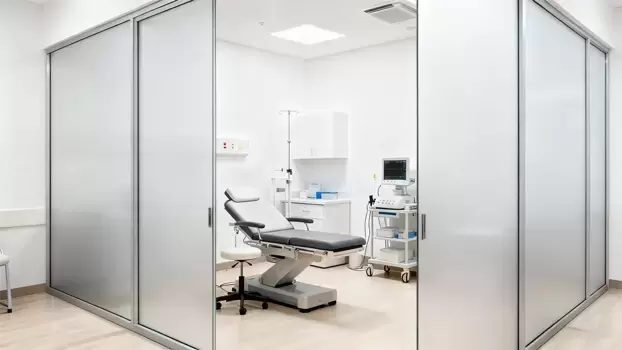
Daylight has become an increasingly important consideration in healthcare architecture.
Large windows and internal glazed partitions can bring natural light deeper into buildings. In areas where patients may spend considerable time, a brighter environment can also make spaces feel less enclosed.
But increasing the amount of glass also increases the number of situations where visual control is required.
Consider a clinic with several examination rooms arranged along a corridor. Clear internal glazing can help staff identify occupied spaces and maintain visual connection. Permanent opaque partitions, on the other hand, may require more artificial lighting and create a more closed environment.
There is no universal answer.
The right solution depends on room function, patient flow, staff workflow, and the degree of privacy required.
This is where Switchable Smart Film can become part of the architectural specification rather than simply an interior accessory.
A glass partition can provide openness when openness is useful and privacy when privacy becomes the priority.
Design requirement | Fixed clear glass | Frosted glass | Smart Film |
Daylight transmission | High | Reduced | Adjustable by optical state |
Visual privacy | Low | High | Controllable |
Flexible room appearance | Limited | Limited | High |
Retrofit potential | Existing glass remains | Usually requires replacement | Suitable glass may be upgraded with film |
Electronic control | No | No | Yes |
The table also highlights an important point for project teams: Smart Film does not automatically replace every type of healthcare partition. Its value is strongest where a project needs both visibility and privacy at different times.
Medical facilities contain many different spaces, and each has a different relationship with privacy.
The most suitable applications are generally rooms where patient confidentiality matters but permanent visual separation would reduce the usefulness of the space.
Consultation rooms are one of the most straightforward applications.
A doctor may need a private conversation with a patient, while staff may also benefit from being able to confirm whether a room is occupied.
Glass partitions can support daylight and improve the visual connections between spaces, while PDLC Film can provide controlled privacy during consultations.
For clinics with repeated room layouts, consistency is another advantage. A single privacy-control concept can be applied across multiple rooms rather than relying on a mixture of curtains, blinds, and permanently frosted panels.
Treatment areas often have changing privacy requirements.
A physiotherapy room may need an open atmosphere during certain activities, while individual treatment sessions require greater visual separation. In rehabilitation facilities, daylight and openness can be particularly useful because patients may spend extended periods inside the space.
A switchable glass partition can allow the same room to serve both conditions.
For facility planners, that flexibility can be more valuable than simply increasing the amount of glazing.
Patient rooms require a more careful approach.
Not every patient room needs Smart Film, and privacy requirements vary considerably between hospitals, clinics, assisted-care facilities, and private healthcare environments.
Potential applications include internal observation panels, room dividers, bathroom glazing, and selected partitions where staff visibility and patient privacy need to coexist.
The specification should follow the clinical workflow rather than treating Smart Film as a standard component for every room.
Diagnostic environments can also involve controlled visibility.
Certain areas need to remain visually accessible to staff while limiting unnecessary exposure to patients or visitors. In such cases, switchable glazing can provide a useful intermediate solution.
However, medical imaging rooms, radiation-controlled spaces, fire-rated partitions, and other highly regulated areas require project-specific specifications. Smart Film should never be selected without checking the performance requirements of the complete glazing assembly.
A good healthcare building has to work for more than one group of people.
There are patients, doctors, nurses, technicians, cleaning teams, administrators, and visitors moving through the same environment.
Each group sees privacy differently.
For patients, privacy means not being unnecessarily visible during vulnerable moments.
For medical staff, visibility can help with room management and patient observation.
For facility managers, flexibility can reduce the number of different partition systems required throughout a building.
For architects, controlled glazing provides another way to balance daylight, circulation, and separation.
That makes Smart Film interesting from an operational perspective.
It does not simply change the appearance of a partition. It allows room visibility to become part of the operating logic of the space.
In a busy outpatient center, for example, glass can remain transparent when a room is being prepared or cleaned. Once a patient enters and privacy is required, the glazing can switch to its diffused state.
That is a small operational adjustment, but repeated across dozens of rooms, it can become part of the facility's daily workflow.
Fixed frosted glass remains a reliable and relatively simple material. For rooms that require permanent privacy, there may be no reason to introduce electronic switching.
The decision becomes more interesting when room conditions change throughout the day.
A hospital corridor may benefit from visual connections during normal operation. A treatment room may require privacy only during specific procedures. A consultation room may alternate between preparation, consultation, cleaning, and occupancy.
In these circumstances, fixed frosting cannot respond to the changing function of the room.
Smart Film provides that additional layer of control.
The comparison should therefore focus on functional flexibility, rather than claiming that one product is universally better.
Factor | Fixed frosted glass | PDLC Smart Film |
Privacy | Permanent | Switchable |
Transparency | Permanently reduced | Available when required |
Moving parts | None | None at glass surface |
Control system | Not required | Required |
Existing glass retrofit | Limited | Possible for suitable substrates |
Long-term operation | Simple | Requires electrical components |
Best suited to | Permanently private areas | Areas with changing privacy needs |
For healthcare procurement teams, this distinction helps prevent unnecessary specification.
If a room must always remain private, ordinary frosted glazing may be sufficient.
If a room alternates between open visibility and privacy, a Switchable Film system deserves closer consideration.
The installation strategy depends heavily on whether the project is new construction or renovation.
New healthcare facilities offer more freedom during the design stage. Glass dimensions, laminated structures, electrical routes, control systems, framing, and adjacent finishes can be coordinated before construction begins.
A Laminated Smart Film solution can be incorporated into the glazing package when the project requires an integrated system.
Renovation projects present a different challenge.
Hospitals and clinics often cannot simply shut down an entire floor while interior partitions are replaced. Work has to be coordinated around patient schedules, medical operations, infection-control requirements, and building access.
Where existing glass is suitable, Self Adhesive Smart Film may provide an alternative for selected retrofit applications.
Instead of removing the original glass, a film can be applied to the existing surface under appropriate conditions. This can reduce the amount of demolition involved in some interior upgrades.
That does not mean every existing glass panel is suitable. Glass type, surface condition, dimensions, edge details, exposure, and electrical routing all need to be checked before specification.
For renovation teams, however, the possibility of upgrading existing glazing can make Smart Film worth evaluating.
Healthcare projects demand more technical discipline than ordinary interior applications.
A product may look excellent in a showroom and still be unsuitable for a particular hospital project if the surrounding glass system has not been properly considered.
Several points deserve attention before procurement.
The glass substrate should be reviewed first.
Thickness, type, dimensions, surface condition, coatings, curvature, and existing frame construction can affect the appropriate Smart Film configuration.
PDLC systems require a power supply and control arrangement.
Wiring should be coordinated with partitions, ceilings, frames, wall cavities, and maintenance access. Concealed wiring is often preferred in healthcare interiors because exposed cables can interfere with cleaning and create unnecessary visual clutter.
Film edges and electrical connection points need suitable protection according to the installation environment and product specification.
This becomes particularly important in spaces exposed to frequent cleaning, moisture, or repeated contact.
Healthcare facilities operate under demanding cleaning schedules.
The cleaning method used on Smart Film should follow the supplier's requirements. Abrasive materials, unsuitable chemicals, or excessive moisture around vulnerable edges can affect long-term performance.
Facility managers should also make sure housekeeping teams understand which cleaning products and methods are appropriate.
Large medical spaces may require multiple independently controlled glass areas.
A consultation room may need one control zone, while a larger treatment area may need several sections. Control planning should therefore be discussed at the design stage rather than added after the glazing has already been installed.
A technically responsible specification also requires knowing where Smart Film is not the primary solution.
Healthcare buildings contain areas governed by strict performance requirements.
Fire-rated partitions, radiation-shielded spaces, specialist imaging rooms, acoustic barriers, security glazing, and structural glazing all have requirements that extend beyond visual privacy.
Smart Film cannot substitute for those functions.
For example, if a partition requires a specific fire-resistance rating, the complete glazing assembly must meet that requirement. Adding a privacy film does not automatically provide the necessary fire performance.
Acoustic performance also needs separate consideration. A switchable film can control visibility, but it should not be treated as an acoustic barrier.
Water exposure is another consideration. A wet-area application needs appropriate edge protection, installation conditions, and product selection.
This kind of limitation is important because it keeps the specification grounded in building performance rather than product marketing.
The wider trend in healthcare architecture is toward spaces that can adapt to changing needs.
Hospitals are dealing with changing patient volumes, different treatment models, renovation requirements, and greater expectations around patient experience. Clinics and specialist facilities are also using smaller footprints more efficiently.
Flexible partitions are part of that shift.
Glass provides visual openness and daylight. Movable partitions provide physical flexibility. Smart Film adds another layer by allowing the visual condition of a fixed glass surface to change without physically moving the partition.
That combination can be particularly useful in areas where room functions overlap.
A consultation room may become a meeting space. A rehabilitation area may be divided during treatment sessions. A private clinic may use glass partitions to create openness during normal operation while maintaining confidentiality during appointments.
The architecture does not have to change every time the room's function changes.
The glass can respond instead.
Patient experience is increasingly considered alongside clinical performance.
Lighting, acoustics, material selection, circulation, privacy, and access to daylight all influence how people experience a healthcare facility.
Glass can contribute positively to several of these goals, but uncontrolled transparency can create discomfort.
A patient waiting for an examination may not want to be visible to everyone passing through a corridor. A person receiving treatment may prefer a private environment. At the same time, completely enclosed rooms can feel isolated.
Smart Film occupies a useful middle ground.
It allows designers to preserve the architectural benefits of glazing without permanently accepting its privacy limitations.
For healthcare operators, that can mean fewer compromises between visual openness and patient dignity.
For architects, it creates another material option when developing interior layouts.
For contractors, it introduces a system that must be coordinated carefully with glazing, electrical work, and finishing trades.
For product managers and procurement teams, the important question becomes whether the technology solves a real operational requirement within the building.
The strongest healthcare applications are rarely the ones where Smart Film is added simply because a project wants more technology.
A better approach starts with the room.
What happens there?
Who needs to see inside?
When does privacy become necessary?
Does daylight matter?
Will the glass remain in place for many years?
Can the electrical system be maintained?
Is the existing glazing suitable for retrofit?
Once those questions are answered, the role of Smart Film becomes much clearer.
This approach also helps differentiate between Smart Glass Film, laminated glazing, and retrofit film solutions.
There is no single configuration for every healthcare project.
A newly constructed private hospital may prefer integrated laminated glazing. A clinic renovating ten consultation rooms may place greater value on retrofit Self Adhesive Smart Film. A rehabilitation center may need large switchable partitions with independent control zones.
Product selection should follow those requirements.
Healthcare architecture has to balance several needs at once: patient privacy, staff visibility, natural light, efficient use of space, cleaning, maintenance, and long-term building performance.
Glass can support many of those goals, but permanent transparency is not appropriate for every situation.
PDLC Smart Film provides a way to make selected glass partitions more responsive to changing room conditions. Clear visibility can be retained when it helps with daylight, circulation, or staff awareness. Privacy can be introduced when consultation, treatment, or patient care requires it.
For new construction, Laminated Smart Film can be considered as part of an integrated glazing specification. For suitable renovation projects, Self Adhesive Smart Film offers another route for upgrading existing glass without automatically replacing the entire partition.
The strongest applications are not necessarily the most visually impressive ones. They are the spaces where a building genuinely benefits from being able to change between openness and privacy.
As medical facilities place greater emphasis on patient-centered environments, flexible room planning, and efficient use of interior space, controllable glazing has a practical role to play. Smart Film is one component within that broader building system, and its success ultimately depends on whether the product, glass assembly, electrical controls, installation method, and operational requirements have been considered together.