How to Install Intelligent Smart Film on Windows Step by Step
Learn more >


Hotel bathrooms have changed considerably in recent years. A bathroom is no longer treated simply as a service space hidden behind a solid door. In many contemporary hotels, especially upscale and lifestyle properties, designers are opening the bathroom toward the bedroom with large glass panels, frameless partitions, walk-in showers, freestanding bathtubs, and integrated vanity areas.
That shift creates an interesting design problem: how much openness is appropriate, and when does a guest need privacy?
Recent hospitality design discussions in 2026 show a stronger focus on wellness, calm interiors, natural materials, and spaces that feel less institutional. Bathrooms are becoming part of the guest-room experience rather than a completely separate utility zone.
At the same time, guest feedback has exposed a weakness in some open bathroom layouts. Glass can make a room feel larger and brighter, but fixed transparent glass does not give occupants any control over visibility. Reports from the hospitality sector have pointed to privacy concerns associated with open bathrooms, sliding panels, and extensive glazing.
For hotel owners, architects, and interior contractors, this is where Smart Film becomes more than a decorative feature. A properly specified PDLC Smart Film system can give a glass partition two different functions: openness when transparency is preferred and visual privacy when the bathroom is in use.
Walk into a recently renovated hotel room and there is a good chance the bathroom will look very different from a conventional residential bathroom.
Solid walls are increasingly being replaced by partial glass partitions. Shower enclosures are larger. Vanity areas may sit directly within the bedroom. In premium suites, a bathtub can even become part of the main visual composition.
Several forces are behind this change.
Hotels want rooms to feel larger without increasing the actual floor area. Glass allows daylight to travel farther into the room, while reflective surfaces and carefully controlled lighting can make compact spaces feel more generous. At the premium end of hospitality, bathrooms are also becoming part of the wellness experience, with larger showers, spa-style features, natural finishes, and calmer lighting increasingly appearing in specifications.
For designers, however, openness creates a practical contradiction.
A guest may appreciate a bright bathroom during the day but want complete visual separation when taking a shower or using the toilet. A fixed frosted panel solves privacy but permanently removes transparency. A curtain solves privacy but introduces fabric, tracks, folds, and another visible component into a carefully considered interior.
A switchable glass surface approaches the problem from a different direction.
Bathroom requirement | Conventional solution | Smart Film approach |
Visual openness | Clear glass | Clear state when required |
Privacy | Frosted glass or curtain | Privacy state at the touch of a control |
Flexible room appearance | Manual blinds or panels | Electronic switching |
Existing glass renovation | Glass replacement | Self Adhesive Smart Film for suitable glass |
Minimalist interior | Additional hardware | Film remains close to the glass surface |
That distinction matters in hotel projects because the bathroom is part of a repeatable room concept. A solution that works in one demonstration room must also make sense across dozens or hundreds of rooms.
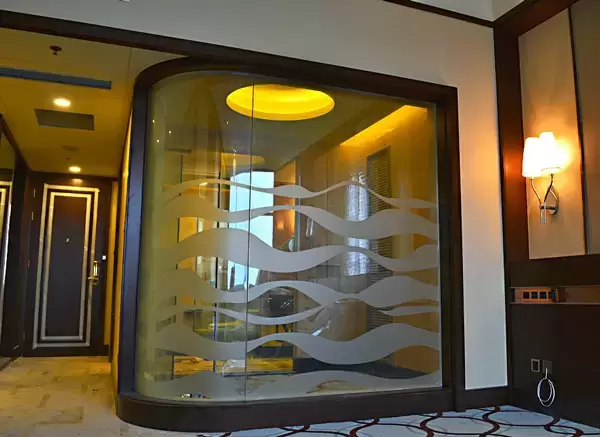
The privacy issue is easy to underestimate during the design stage.
Architects often evaluate a bathroom partition from the perspective of circulation, lighting, sightlines, and visual continuity. A guest evaluates it differently. Once occupying the room, personal privacy becomes much more important than the appearance of a floor plan.
Recent hospitality coverage has highlighted guest dissatisfaction with bathroom layouts that rely heavily on open arrangements or glass without sufficient privacy control.
For a hotel operator, that can create a difficult balance.
A completely enclosed bathroom provides privacy but can make a compact room feel smaller. A completely open bathroom provides visual continuity but may not suit every guest, particularly in rooms shared by colleagues, friends, or family members.
Privacy Smart Film offers a middle position.
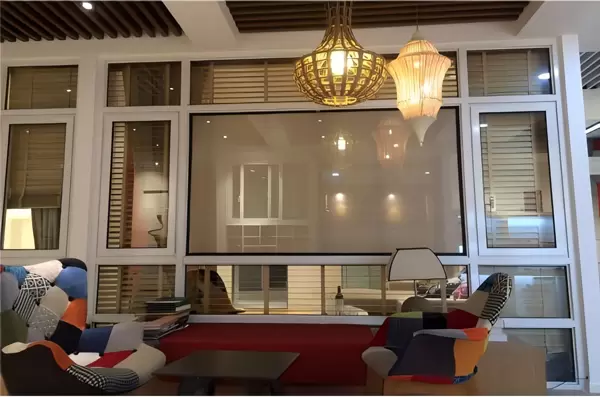
The glass can remain transparent when the bathroom is not being used. When privacy is required, the PDLC layer changes to a diffused appearance, reducing clear visibility through the glass.
That small change in function can have a substantial effect on room planning.
The same glass panel can support:
· An open visual connection between bedroom and bathroom during normal room use.
· Private showering, dressing, or personal care without installing a curtain.
· Flexible separation in suites where bathroom and bedroom areas are closely connected.
· A cleaner visual appearance for hotels pursuing contemporary or minimalist interiors.
For hospitality designers, that flexibility is often more valuable than simply adding another piece of “smart” technology.
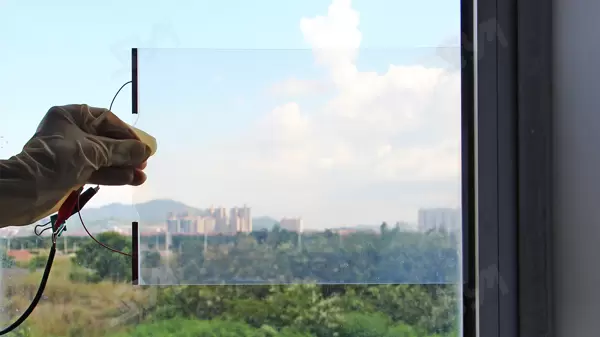
The basic operating principle is straightforward. A PDLC layer contains liquid crystal material between conductive layers. Electrical control changes the optical state of the film.
Powered operation can produce a transparent appearance, while the non-powered state creates light scattering and visual privacy, depending on the product configuration.
For hotel bathrooms, the important point is not the switching mechanism itself. It is what that mechanism allows the glass to do within a room.
A conventional glass partition has one permanent optical condition.
A Switchable Smart Film partition can respond to occupancy and guest preference.
That makes it particularly suitable for rooms where the bathroom and bedroom are visually connected.
During daytime use, clear glass allows light from the bathroom area to contribute to the overall room environment. A compact guest room can feel less divided, while architectural details such as stone, wood, lighting, and sanitary fittings remain visible.
For luxury hotels, this matters because the bathroom is often part of the visual identity of a room. Expensive finishes hidden behind an opaque wall do not contribute much to the guest's first impression.
Once privacy is needed, a control signal can switch the film to its diffused state.
There is no curtain to draw across the glass and no heavy blind mechanism occupying wall or ceiling space.
A guest can therefore move between openness and privacy without changing the physical arrangement of the room.
A major advantage of Smart Glass Film is that it remains close to the glass surface.
That suits hotel interiors where designers are trying to remove visual clutter. Modern hospitality projects increasingly favor restrained detailing, integrated lighting, natural finishes, and fewer obvious mechanical components.
A smart film system can fit within that language more naturally than a conventional curtain assembly.
Hotel procurement teams should not treat every Smart Film project in the same way.
A new hotel and an operating hotel have completely different construction conditions.
During new construction, the glazing specification can be coordinated from the beginning. Film type, glass structure, busbar position, wiring routes, control systems, frame details, and access for maintenance can all be discussed before production.
For a renovation project, the situation is more complicated.
Existing glass may already be installed. Removing it can involve demolition, transportation, replacement glazing, finishing work, and room downtime. If the existing glass is structurally suitable, Self Adhesive Smart Film can provide another route for selected retrofit applications.
Shuifa Singyes currently offers self-adhesive Smart Film for application onto existing glazing, with product information covering clear float glass, tempered glass, laminated glass, and selected Low-E configurations.
This is particularly relevant to hotels because renovation work is often carried out room by room.
A property may have to maintain partial occupancy while upgrading bathrooms, corridors, guestrooms, or public areas. Reducing the amount of demolition can simplify coordination between the interior contractor, glazing contractor, electrical team, and hotel operations.
The choice can therefore be viewed in project terms:
Project condition | More suitable direction |
New hotel construction | Laminated Smart Film or Smart Glass coordinated with glazing |
Major bathroom reconstruction | Integrated smart glazing system |
Existing glass retained | Self Adhesive Smart Film where substrate and environment are suitable |
Small number of rooms | Retrofit solution may reduce replacement work |
Large standardized hotel project | Custom sizing and centralized control should be considered |
The decision should always follow the actual glass specification, moisture conditions, frame construction, electrical arrangement, and project requirements rather than simply selecting a film based on appearance.
A hotel bathroom is not an ordinary interior glazing environment.
Steam, condensation, frequent cleaning, temperature changes, and water exposure all affect how a glass assembly should be specified.
That does not mean the PDLC layer is inherently unsuitable for bathrooms. It means the complete installation needs to be treated as a system.
Several details deserve attention during project coordination.
Glass preparation is important because contamination, dust, grease, or surface irregularities can affect film adhesion and optical quality.
Edge treatment deserves particular attention in humid locations. The film edge, busbar area, wiring connection, and surrounding frame should be protected according to the product and installation requirements.
Electrical components should be positioned with appropriate consideration for bathroom electrical zones and local regulations. A Smart Film project is not simply a matter of connecting a transformer to a piece of glass.
Cleaning procedures also need to be communicated to housekeeping teams. The glass surface and film edges should be treated according to the supplier's maintenance recommendations, particularly around exposed edges and electrical connection areas.
For hotel operators, these details matter because a room may be cleaned hundreds of times over its service life.
One of the more interesting applications is renovation.
Imagine a hotel built ten years ago with ordinary clear glass between the bedroom and bathroom. The glass itself may still be perfectly usable. The problem is that its function has not changed with the hotel's interior concept.
Replacing the entire partition can be expensive and disruptive.
A suitable Self Adhesive Smart Film can potentially turn that existing glass into a switchable privacy surface without removing the original panel.
That creates an interesting option for:
· Boutique hotel refurbishment.
· Resort room upgrades.
· Business hotel bathroom renovations.
· Serviced apartment conversions.
· Premium residential hospitality projects.
The value here is not simply installation speed. Keeping existing glass can reduce the amount of material that has to be removed from the building and limit work around finished floors, walls, ceilings, and sanitary equipment.
Shuifa Singyes already positions self-adhesive film as a retrofit product for existing glazing, while its project examples show Smart Film being used in hospitality-related environments.
That makes retrofit a meaningful part of the product discussion rather than a secondary application.
Smart Film should not be selected solely from a product photograph.
For a hotel project, the specification should begin with the actual room conditions.
Does the glass need complete visual obscuration, soft diffusion, or simply reduced visibility?
A guest bathroom beside a bed may have different requirements from a shower enclosure or a toilet cubicle.
Glass thickness, type, size, edge condition, and existing coatings can affect product selection and installation.
For a new-build project, laminated Smart Film or Smart Glass can be coordinated with the glazing package.
For existing rooms, Self Adhesive Smart Film may provide a more practical route when the existing glass is appropriate.
Switch location, concealed wiring, power supply, control zones, and access for service should be coordinated before interior finishes are closed.
A hotel does not operate like a private residence. Cleaning frequency, staff procedures, replacement access, and long-term durability all have to be considered.
These decisions are not glamorous, but they are often what separates a successful hotel installation from a product that looks impressive during the opening ceremony and becomes inconvenient later.
There is a broader reason Smart Film is attracting attention in hospitality.
Hotel design in 2026 is moving toward spaces that feel calm, personal, and less visually crowded. Designers are also paying more attention to wellness, lighting, material quality, and how guests experience a room rather than simply how the room photographs.
Bathroom design is following the same direction. Larger showers, integrated vanities, natural finishes, softer lighting, and spa-like layouts are increasingly common in contemporary projects.
Smart Film fits into this movement because its main contribution is not another visible object.
It changes the behavior of an existing surface.
That distinction is important.
A curtain adds a physical layer.
A blind adds hardware.
A permanent frosted panel fixes the privacy condition.
PDLC technology allows the glass to respond to different moments of use while keeping the overall room visually clean.
For hotel developers, that can be a useful combination of architectural appearance and operational flexibility.
Not every hotel bathroom needs electronically controlled glass. A conventional partition remains the sensible choice in many standard rooms.
The strongest cases are usually spaces where visual openness has a clear architectural purpose and privacy changes throughout the day.
Typical candidates include:
· Luxury hotel suites with open bedroom-bathroom layouts.
· Boutique hotels using glass as a major interior feature.
· Resorts where natural light and landscape views are important.
· High-end serviced apartments with limited floor area.
· Renovation projects retaining existing glass partitions.
For these projects, the decision should be based on the relationship between privacy, room layout, guest expectations, construction method, and lifecycle maintenance.
There is an important engineering point worth making.
Smart Film cannot solve every problem created by an open bathroom.
It does not replace acoustic separation. It does not replace waterproofing. It does not replace ventilation. It does not turn unsuitable glass into a suitable structural element.
If a hotel room requires sound isolation, odor control, fire-rated construction, accessibility compliance, or specific wet-area protection, those requirements still need to be addressed independently.
Smart Film handles a narrower but valuable part of the problem: controlling visual privacy and light transmission through glass.
That clarity is useful when discussing specifications with architects and contractors.
A good product should not be asked to perform functions outside its intended role.
Hotel bathrooms are becoming more visible, more open, and more closely connected to the overall guest-room experience. At the same time, guests still expect a private space when they need one. That tension will remain as long as hotels continue using glass to create brighter, more spacious interiors.
Smart Film offers a practical response because it allows one glass surface to serve different purposes at different times.
Clear glass can preserve openness and natural light. A privacy state can provide visual separation when the bathroom is occupied. For new developments, laminated Smart Film or Smart Glass can be incorporated into the glazing specification. For selected renovation projects, Self Adhesive Smart Film can provide a way to upgrade existing glass without replacing an otherwise serviceable partition.
For hotel owners and project teams, the strongest case is not simply that Smart Film is a “smart” bathroom feature. Its real value comes from solving a familiar architectural compromise: keeping a bathroom visually open without making privacy permanent or dependent on a curtain.
As hospitality design continues to place greater emphasis on wellness, personal comfort, cleaner interiors, and long-term operational value, that kind of flexibility has a practical place in modern hotel projects.