Comparing different types of ITO films for touch screens
Learn more >


The modern office wants two things at the same time: openness and privacy.
Glass partitions look clean and make spaces feel bigger, but they also expose screens, whiteboards and sensitive conversations. Curtains and blinds are often an afterthought, and they do not match the minimalist look many companies want.
That is why more designers, contractors and corporate owners are looking seriously at switchable PDLC film for offices. It delivers on-demand privacy without giving up daylight or the open, transparent feeling of glass.
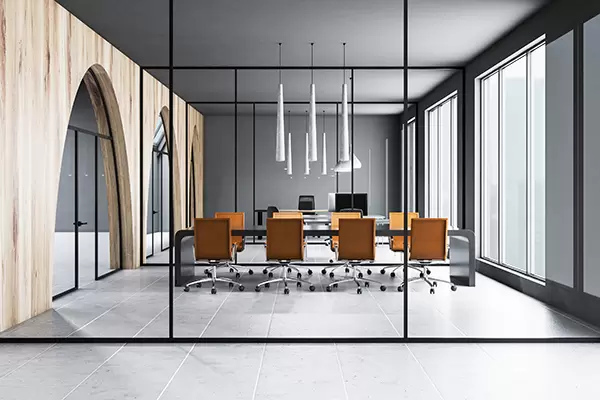
This article looks at what switchable PDLC film is, how it actually works in office projects, and what you should know before choosing a supplier such as Shuifa Singyes New Materials.
Main product references:
PDLC (Polymer Dispersed Liquid Crystal) film is a functional interlayer that changes from frosted to clear when power is applied.
Power off: film looks frosted, people cannot see details
Power on: film becomes transparent, you can see through the glass normally
In an office, that means:
A meeting room wall that is fully open visually during normal operation
One switch or button that turns it into solid privacy when needed
A surface that can also work as a projection screen in many cases
PDLC can be used in two main forms:
Smart film – installed on existing glass (self-adhesive) or laminated inside new glass
Smart glass – factory-laminated glass panels with PDLC in the middle
Shuifa Singyes New Materials supplies both smart film and smart glass, depending on whether it is a renovation or a new fit-out.
If you look at a typical floor plan, there are several obvious zones where switchable PDLC film for offices can add value immediately.
This is the most common application.
During normal operation, rooms stay transparent to keep an open feel
When confidential content appears on a screen, the wall is switched to frosted
Internal users no longer stick paper or tape on the glass for privacy
Benefits:
One surface can work as glass, privacy wall and projection screen
Visitors see a modern, clean look instead of blinds and curtains
Facility teams avoid constant cleaning and replacement of fabric blinds
Senior offices often have glass fronts so managers can stay visually connected with the team, but they still need privacy for calls and decisions.
Switchable PDLC film allows:
Transparent glass during daily work
Frosted glass during sensitive calls or one-on-ones
Quick change without drawing curtains or moving panels
Focus rooms and phone booths benefit in the same way.
Departments dealing with personal or financial information need both:
Confidential conversations inside
A visible and welcoming design outside
Switchable film makes it easy to keep privacy when needed but keep the corridor side visually light and open when rooms are unused or in general operation.
In open-plan offices, switchable film can be used to:
Divide a large space into zones for workshops or training
Turn a transparent glass wall into a temporary whiteboard background or projection surface
Provide visual focus for staff during intense work periods
Instead of building permanent walls, smart glass partitions allow the same area to be used in multiple ways throughout the week.
Before investing in technology, many owners ask: why not just use blinds, curtains or standard frosted glass?
A simple comparison helps.
Pros
Low initial cost
Easy to understand for users
Cons
Collect dust and are harder to clean
Often look messy when half-open or left at odd angles
Block daylight the same way, whether privacy is really needed or not
Mechanisms can wear out or break, especially in high-use meeting rooms
Pros
Clean, permanent look
No moving parts, low maintenance
Cons
Always closed visually, even when privacy is not needed
Reduces the sense of openness the company wanted when choosing glass
Cannot be turned into a projection screen
Pros
One-glass solution: open feel + instant privacy on demand
Supports multiple uses: privacy, design, projection, branding
Easy to clean like normal glass
Can be integrated with switches, remote, timers or building management systems
Cons
Requires proper design for power, wiring and control
Needs a reliable manufacturer and installer who understands the technology
For many companies, the combination of flexibility, aesthetics and function is what justifies moving from static solutions to PDLC smart film or smart glass.
When you work with a manufacturer like Shuifa Singyes New Materials, you usually discuss whether to use smart film or smart glass.
Best for:
Renovations where existing glass partitions already exist
Projects where downtime must be kept short
Tenants who do not want to replace glass or touch the structure
Key points:
Film is applied directly to clean glass surfaces
Wires and busbars are planned to hide within frames or ceiling details
Can be installed room by room in a live office environment
You can see typical configurations here:
Smart film products for office partitions
Best for:
New build or full fit-out projects
Façade or external applications where safety glass requirements exist
High-end, long-term corporate offices where structure and design are fixed
Key points:
PDLC film is laminated inside the glass at the factory
Glass arrives at site as a finished smart glass panel
Often used where higher acoustic or structural performance is required
More information is available here:
Smart glass solutions for architectural projects
In practice, many projects use a mix. For example, boardroom fronts may use smart glass, while internal retrofits on existing glass partitions use self-adhesive smart film.
To make switchable PDLC film for offices work smoothly, a few technical points must be addressed at design stage.
Office partitions are rarely all the same size. A professional manufacturer will:
Receive detailed panel dimensions
Keep PDLC film at a safe distance from the glass edge
Place busbars where wiring can be hidden
Shuifa Singyes New Materials offers custom size cutting to match each panel, which reduces on-site trimming and risk.
You will need to decide:
Which panels or rooms are controlled together
Where switches or control points are located
Whether to integrate with meeting room booking systems or smart office platforms
Power supplies, transformers and control units must be placed where maintenance access is available. Good coordination between MEP engineer, partition contractor and smart film supplier is crucial.
Different office areas may require different effects:
Standard white PDLC film for general meeting rooms
Grey smart film for areas needing more glare control or a tinted look
Projection-optimized film for rooms where the glass wall is also a screen
A supplier like Shuifa Singyes New Materials can advise based on their range of smart film options and real office project experience.
To make this more concrete, here are a few typical layouts.
Glass-walled boardroom along the facade
Series of small meeting rooms facing an internal corridor
HR and finance rooms along the core
Solution:
Smart glass for the boardroom window wall and doors
Self-adhesive smart film on internal meeting room partitions
PDLC partitions for HR and finance with independent switches inside each room
Benefits:
Consistent visual language across the floor
Privacy only when needed, keeping the floor bright at other times
Clear signal of confidentiality when glass goes opaque
Modular glass rooms used as either private offices or meeting rooms
Frequent tenant changes and layout adjustments
Solution:
Self-adhesive PDLC film applied to standard glass modules
Centralized control interface plus room-level switches
Branding or signage applied on top of the smart film where needed
Benefits:
Operator can adapt the same glass modules for different uses
PDLC film moves with the glass modules instead of building new walls
Space value increases due to flexibility and premium experience
Shuifa Singyes New Materials is more than a trader of finished film. It is a vertically integrated smart materials manufacturer, with:
In-house ITO film production on roll-to-roll lines
PDLC formula development and wet-process coating
Smart film production, cutting and lamination
Smart glass manufacturing capacity and smart projection system development
For office customers, this means:
Consistent quality from batch to batch
Ability to handle large-scale roll production and precise custom cutting
Support for both smart film retrofits and smart glass new build projects
By sharing your office drawings, panel sizes and control requirements, you can work with their technical team to design a complete switchable PDLC film for offices solution, not just a list of materials.
Before you send an inquiry, prepare:
Floor plan and glass schedule
Mark which partitions and doors should be switchable
Panel dimensions and construction
Indicate which are existing glass and which are new
Frame and ceiling details
So wiring and busbars can be hidden
Control strategy
Simple wall switches, remote, or integration with a control system
Timeline and phasing
Whether the office is live, under renovation, or being built from scratch
With this information, Shuifa Singyes New Materials can give you clear technical advice and a realistic plan, instead of only a catalogue and a unit cost.
Service life depends on several factors: film quality, power supply stability, installation quality and environment. In a normal air-conditioned office with proper edge sealing and wiring, well-manufactured PDLC smart film is designed for long-term daily switching.
Key points:
Use a stable power supply designed specifically for PDLC
Avoid water ingress at edges and wiring points
Follow the manufacturer’s installation guidelines and edge-clearance requirements
When you work with a vertically integrated manufacturer such as Shuifa Singyes New Materials, film, power and installation design are considered together to support long-term use.
Switchable PDLC film draws power only when it is in the transparent (ON) state. Power consumption per square meter is modest and typically much lower than running HVAC or lighting in the same space.
For office use, the main practical points are:
Group panels so that only necessary zones are switched on
Turn panels off after meetings to reduce running time
Make sure power supplies are correctly sized to avoid overload
Good control design (grouping, switches, integration with room booking systems) has more impact on actual consumption than the film itself.
PDLC smart film itself is a thin functional layer; it does not replace proper acoustic design. However:
When laminated inside smart glass, combined with multiple glass layers and interlayers, the complete glazing can provide better sound reduction than single glass.
The frosted OFF state also helps visually “close” the space, which psychologically supports a sense of privacy during confidential meetings.
If acoustic performance is a priority, the smart film supplier and glass processor should work together to choose appropriate glass thickness and interlayer configuration.
From a facility team perspective, cleaning is straightforward:
Treat the glass surface like standard interior glass
Use neutral glass cleaner and soft cloths or squeegees
Avoid abrasive pads, strong solvents or sharp tools on the film surface
For self-adhesive smart film, do not scrape aggressively on edges or busbar areas. Proper cleaning extends not only visual clarity but also the professional appearance of high-traffic meeting rooms.
Yes, when designed and installed correctly:
PDLC film operates at a low working voltage provided by a dedicated transformer or controller
High-voltage AC from the building is converted to a specific, controlled output for the film
Busbars and connection points are kept behind frames or protected profiles
Work with manufacturers such as Shuifa Singyes New Materials who supply both smart film and matching PDLC power supplies, and follow their wiring and protection guidelines.
Installation time depends on:
Whether you use self-adhesive smart film on existing glass or install new smart glass panels
The number of panels and complexity of wiring
Site access and working hours
In a typical office renovation:
Self-adhesive film can often be installed room by room, with a short downtime per room
Smart glass usually follows the normal glazing schedule of the partition contractor
Good preparation—panel list, wiring diagrams, power supply locations—has more impact on timeline than the film technology itself.
Yes, many offices use switchable PDLC film for projection:
In the OFF (frosted) state, the film can act as a rear or front projection surface
This allows the same glass wall to be both a privacy screen and a presentation screen
Content can be viewed from one side or both sides depending on the room design
If projection is an important function, tell the supplier in advance. They can recommend film types optimized for contrast and viewing angles, and suggest projector positioning.
By default:
When power is off, PDLC film goes to its frosted state
That means privacy is maintained even if supply is lost
This “fail-safe” behavior is actually an advantage for offices dealing with confidential meetings or sensitive information.
Yes. In many modern offices, PDLC film is linked with:
Room booking systems – glass turns frosted when a meeting starts
Smart office control platforms – film grouped with lighting and shades
Centralised control panels – facility teams can manage entire zones
When you plan your project, share your integration requirements with Shuifa Singyes New Materials so that power, control modules and wiring layouts are designed to work with your chosen system.
In short:
Switchable smart film (especially self-adhesive) is ideal for renovation or when you want to upgrade existing glass partitions without major construction.
Smart glass is better for new builds or full fit-outs, where laminated safety glass with PDLC inside is specified from the start.
Because Shuifa Singyes New Materials produces both smart film and smart glass, they can help you choose the best option or combination for each office area instead of pushing a single product.