Why Is Smart Film Becoming a Practical Choice for Hotel Bathrooms?
Learn more >


When people talk about automotive “smart film”, most of the discussion stays at the surface: glass that can turn from clear to fogged with a button. But if you are an OEM, a tier-1 supplier or a serious modifier, you know the real questions are more practical:
Will it still work at -30°C in winter and 100°C in summer?
Does it really block heat or is it just a visual effect?
Can it be customized to my exact sunroof or side window shape?
Is there a custom PDLC film producer who can support dozens of different vehicle models, not just a demo panel?
This is exactly where Shuifa Singyes New Materials positions its automotive smart film: as a stable, wide-temperature, highly customizable solution built on Polymer Dispersed Liquid Crystal (PDLC) technology.
Main product reference:
Automotive smart film solution overview
A lot of suppliers can show you a small sample that switches between clear and frosted. That alone does not make them a custom PDLC film producer for vehicles.
For automotive, “custom” has a much deeper meaning:
Custom temperature range: the film must work from -30°C to 100°C, following the reality of parked cars under the sun and cold starts in winter.
Custom size and shape: every sunroof, quarter glass and privacy partition is different; tight curves and complex outlines are normal.
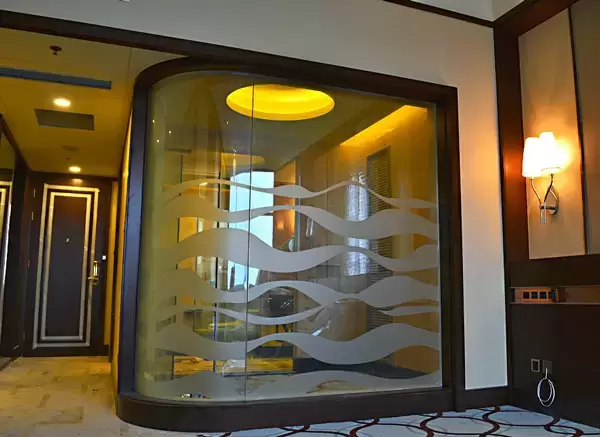
Custom patterns: many brands want etched patterns, zones or special visual effects that match their design language.
Custom control logic: the way the film turns on and off must match each vehicle’s electrical architecture and UX concept.
Shuifa Singyes New Materials has taken its wide-temperature liquid crystal dimming film technology and pushed it into the automotive sector specifically to answer these points, not just to add another “smart film” catalog item.
At the heart of automotive smart film is Polymer Dispersed Liquid Crystal (PDLC):
In the power-off state, LC droplets are randomly oriented, scattering light and creating a fogged, privacy-friendly appearance.
When power is applied, droplets align, allowing light to pass and making the film appear clear.
For vehicles, Shuifa Singyes New Materials adjusts PDLC formulation and structure to:
Maintain stable switching under large temperature variations
Balance light transmission, privacy and glare control
Keep response times fast, even on large panoramic sunroofs
Cooperate with automotive-grade power supplies and control systems
Instead of a one-recipe-fits-all approach, the PDLC system is tuned around real automotive use.
A passenger car’s glass environment is brutal:
In winter, cabins can drop well below freezing overnight.
In summer, parked under strong sunlight, interior surfaces can exceed 70–80°C; the glass area can approach 100°C.
A PDLC film that works only in a narrow “lab” range is not acceptable. Shuifa Singyes New Materials’ automotive smart film is developed as wide-temperature smart film, designed for stable operation from -30°C to 100°C.
What that means in practice:
No noticeable slow switching on cold mornings
No “sticking” or failure after multiple hot summers
Stable optical performance across seasons, not only when the car is new
For OEMs and high-end retrofit projects, this wide-temperature reliability is often the line between a premium feature and a recurring warranty headache.
A good automotive smart film is more than a simple on/off privacy layer. Used correctly, it is a multi-function, one-touch intelligent system that combines:
Clear mode for maximum openness and daylight
Fogged mode for diffused light and reduced glare
Optional intermediate control depending on the electrical design
From highways at noon to city streets at night, the driver can adapt cabin light conditions quickly, improving comfort and visibility.
Heat is not just about comfort; it affects:
Air-conditioning load
Fuel or energy consumption
The perceived “quality feel” of the cabin on hot days
By diffusing direct sunlight and cooperating with heat-absorbing or reflective glazing, PDLC smart film helps reduce the feeling of direct radiation on occupants.
Privacy matters for:
Rear-seat passengers in premium sedans and SUVs
VIP and executive transport
Commercial fleets carrying sensitive goods or high-profile passengers
Fogged mode provides instant privacy without adding permanent dark tint. This is especially valuable in regions where regulations limit very dark side glass.
In Shuifa Singyes New Materials’ automotive smart film, these three functions—light, heat, privacy—are designed to work together, not as isolated add-ons.
“Custom PDLC film producer” also means being able to handle non-standard shapes and visual designs.
Shuifa Singyes New Materials offers:
Highly customized sizing
Tailored shapes for panoramic sunroofs, full-length roof glass and complex side windows
Careful edge design to ensure smooth lamination and sealing
Pattern etching services
Brand logos, graphic lines or zone boundaries integrated into the PDLC layer
Functional zones where only certain areas of the glass switch, supporting advanced UX scenarios
For example:
A sunroof where the front section becomes opaque while the rear stays clear
A side window where a narrow strip is always transparent for mirrors and legal visibility, while the main area switches
A partition glass that can show a pattern or logo subtly in fogged mode
These are difficult or impossible to achieve with off-the-shelf films. A producer that understands both PDLC chemistry and patterning processes can make them work reliably on real cars.
Automotive smart film must be driven by robust, vehicle-grade electronics. Shuifa Singyes New Materials’ solution supports:
Simple one-touch switching via dedicated buttons or touch surfaces
Integration with existing roof or shade controls
More advanced logic, for example:
Automatic fogging when the vehicle is locked
Preset light mode linked to driving profiles
Fleet-level settings for commercial vehicles
The company’s automotive smart film works with mature, stable smart control technology, enabling both manual and flexible autonomous adjustment of light conditions.
That means an OEM can design:
A single button for “privacy mode”
Multiple presets such as “comfort”, “max view”, “rest mode”
Integration with vehicle apps and remote functions
The key is that the PDLC film and electronics are designed together, rather than treated as unrelated modules.
Shuifa Singyes New Materials’ automotive smart film is already deployed across over 40 vehicle models, which shows it is not just at the concept stage.
For private cars, typical use cases include:
Panoramic sunroofs on SUVs and sedans
Fixed rear quarter windows where conventional blinds are impractical
High-end rear passenger partitions in chauffeur-driven vehicles
Owners gain:
Better heat management and comfort in summer
Instant privacy when needed
A premium, tech-forward interior feel
For fleets—ride-hailing, limousine, executive transport, corporate shuttles—PDLC smart film can:
Differentiate service levels (for example, “premium privacy vehicle” tiers)
Support branding and enhanced passenger experience
Reduce the need for physical privacy screens or curtains, which can wear out or look messy
Fleet operators appreciate that the feature is electronic and repeatable, not dependent on passenger handling.
For the growing automotive modification and customization market, a custom PDLC film producer offers:
Retrofit friendly solutions for existing models
Special designs for show cars and brand experience vehicles
Unique visual effects that regular tint film cannot achieve
With stable wide-temperature performance and customization services, Shuifa Singyes New Materials’ film becomes a toolkit for designers and converters, not just a product.
Beyond the basic product, a practical automotive partner needs:
Proven field performance – more than 40 vehicle models already using the film
Automotive-grade thinking – understanding of validation, durability, safety and compliance steps
Scalable manufacturing capability – from trial batches to volume supply
As a custom PDLC film producer, Shuifa Singyes New Materials brings:
Vertical expertise
Liquid crystal dimming film R&D and production
Smart film, smart glass and related optical materials
Integration know-how from buildings to automotive, giving broader perspective on light and heat management.
Engineering support
Collaborative work on glass design, busbar layout and wiring routes
Help aligning PDLC film with vehicle electrical architecture
Guidance on installation, sealing and long-term environmental protection
Customization strength
Tailored shapes, sizes and patterns
Ability to adapt to different OEM design languages and platform constraints
This combination is what turns PDLC smart film from a lab demo into a robust, repeatable feature across multiple vehicle lines.
If you are an OEM, module maker or professional modifier, a simple, phased approach works best.
Clarify:
Which glazing areas will use PDLC (sunroof, side glass, partitions)
What the main goals are (heat reduction, privacy, design signature)
How many vehicle models or variants are affected
Provide:
Glass drawings with curvature, size and thickness
Section drawings showing frames, seals and structural details
Basic electrical architecture related to the smart film feature
Work with Shuifa Singyes New Materials to:
Validate that PDLC film can meet optical and thermal targets
Decide on film structure, busbar positions and wiring routes
Outline control concepts (buttons, presets, integration)
Move to:
Sample panels and prototype vehicles
Electrical and environmental testing (temperature, humidity, cycling, vibration)
User experience evaluations: switching speed, perceived comfort and privacy
Once validated:
Establish mass production parameters and quality controls
Schedule deliveries aligned with SOP timelines
Prepare documentation for service and aftermarket support
With this structured path, PDLC smart film becomes a well-managed feature rather than an experimental add-on.
Automotive PDLC film is formulated and engineered to:
Operate reliably from -30°C to 100°C
Withstand vibration, rapid temperature changes and UV exposure
Fit complex curved glass and tight framing
Building smart film does not normally see such extreme conditions and is not automatically suitable for vehicles.
Yes, in many cases. Retrofit solutions depend on:
Glass structure and accessibility
Electrical system capacity and wiring routes
Regulatory constraints in the target market
Shuifa Singyes New Materials can support projects that use either laminated smart glass replacements or carefully designed retrofit kits, depending on the vehicle.
It can reduce the need for mechanical shades, especially on panoramic roofs and partitions, but final design choices are up to the OEM. Some vehicles may combine both:
PDLC smart film for instant privacy and glare control
Physical shades for additional shading or customer preference
The key is to design them as a system, not as competing elements.
According to the current deployment, the product is used across more than 40 vehicle models, showing that it is not limited to concept cars but has entered wide market application.
Pattern etching can support:
Logos and brand marks
Lines and zones that hint at the smart function
Functional zoning (for example, keeping small fixed transparent strips)
Feasibility depends on glass size, curvature and electrical layout, which are assessed during the design phase.