Can Smart Film Be Installed on Existing Glass Without Replacement?
Learn more >


Open-plan offices look great in renderings: clean lines, glass everywhere, sunlight pouring through the floor. But once teams move in, reality hits fast:
Meeting rooms need real privacy for calls and negotiations
Executives want visibility and quiet at the same time
People get tired of sitting in a “glass box” with constant glare
Blinds and curtains quickly make the space look cluttered and hard to clean
This is exactly where PDLC film for office partition comes in. Built on electrically controlled smart film technology, it lets your glass switch from transparent to frosted in milliseconds, without sacrificing light or modern design.
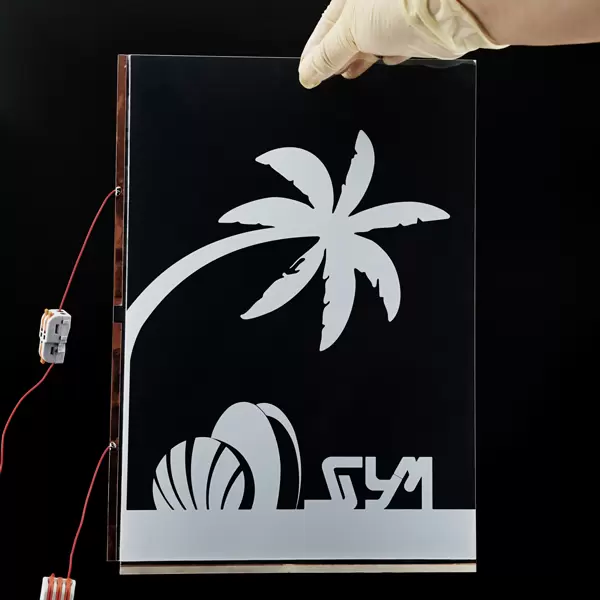
In this article, we’ll walk through how PDLC smart film actually works, what it does better than traditional solutions, and how Shuifa Singyes New Materials uses laminated smart film to solve everyday problems in real offices.
Main product reference:
➤ Laminated PDLC smart film for glass partitions
Smart film (electrically controlled smart film) is an innovative PDLC-based material. In simple terms:
A liquid crystal layer is sandwiched between two flexible transparent conductive films (ITO).
When there is no power, the liquid crystal droplets are randomly oriented, scattering light and making the glass look frosted.
When an electric field is applied, droplets align in one direction, allowing light to pass through and making the glass clear.
Switching happens in milliseconds, which means:
One moment the meeting room is fully open and transparent
The next moment, with a single touch, the glass turns into a privacy wall
For office partitions, PDLC smart film can be laminated inside the glass or installed as a film layer, turning your existing partitions into switchable ones without rebuilding walls.
You could choose frosted glass, blinds or curtains. So why do more and more projects move to PDLC film for office partition?
Many older “smart” or decorative films look:
Slightly cloudy even when clear
Uneven from side angles
Distorted when you look through at a distance
High-quality PDLC smart film from Shuifa Singyes New Materials is designed with:
Multiple light transmittance and haze options – so you can tune between maximum clarity and stronger privacy
A clear, distortion-free view in the transparent state
Strong obscuration in the frosted state, giving both privacy + soft, diffused light
Compared with traditional frosted glass or blinds:
Transparent mode looks more like normal glass
Frosted mode still lets in light, so rooms do not feel like dark boxes
PDLC film is not just about switching privacy. It also offers:
UV blocking to help protect furniture, flooring and artwork from fading
Glare reduction in frosted mode, making screens easier to see
Reduced heat transfer, which helps:
Lower AC load in summer
Retain more heat in winter
For building owners and facility teams, this means a single material contributes to comfort, energy efficiency and aesthetics at the same time.
Office projects now appear in a wide range of climates and building types: high-rises with all-glass façades, atrium spaces, rooftop offices. Smart film needs to cope with:
Temperature swings
Sunlight exposure
Daily switching and cleaning
PDLC smart film from Shuifa Singyes New Materials is engineered for:
Stable performance across extreme temperatures
Excellent anti-aging characteristics
Low maintenance – you clean it like regular glass; there are no mechanical parts like blinds to fix or replace.
One limitation of some smart material solutions is size. If films are too narrow, you end up with visible seams and broken lines across your glass.
Shuifa Singyes New Materials addresses this with:
Max. width up to 2 meters, suitable for full-height partitions and large fixed panes
Unlimited length, supplied on rolls
Cutting to precise sizes to minimize seams
For office partitions, this means:
Floor-to-ceiling switchable glass walls with clean vertical lines
Fewer joints, fewer metal mullions, more seamless design
Simpler integration into standard aluminum or steel frame systems
The result: real flexibility for architects and designers, instead of forcing them to design around small, fixed smart panels.
Modern offices rarely use standalone systems anymore. Lighting, HVAC, access control and booking systems are increasingly connected.
PDLC smart film fits naturally into this shift:
Compatible with major smart building systems
Can be connected to:
Apps
Voice assistants
Light sensors
Temperature sensors
Meeting room booking platforms
Example scenarios:
Auto-frost in strong sun: when a certain lux level is reached on the façade, the partition film facing that side switches to frosted mode, reducing glare and heat.
Privacy on door lock: when a room’s smart lock is engaged for a meeting, the glass automatically turns frosted; when the lock is opened, it turns clear again.
“Presentation mode”: a single button that turns on the projector, dims the lights and frosts the glass, using the partition as a projection screen.
Instead of treating glass as a static material, PDLC film turns it into an active component of the building’s control system.
Traditional glass partitions give you a fixed choice: open or closed. PDLC smart film breaks that limitation.
With PDLC film for office partition, the same room can be:
A transparent collaboration space in the morning
A confidential negotiation room in the afternoon
A projection room for training in the evening
There is no need to build different rooms for every function. You simply redefine the space with one switch.
In open-plan layouts:
Departments change size
Teams reorganize
New project spaces appear and disappear
Laminated PDLC smart film lets you:
Keep the basic glass layout
Change privacy and zoning logic through controls and software, not hammers and walls
Support hybrid work modes where focus, collaboration and online calls are mixed
In short, it helps offices move from fixed walls to dynamic, software-defined space.
It helps to compare PDLC smart film with the “usual” options.
Pros
Low initial cost
Familiar to users
Cons
Collect dust and require more cleaning
Easily damaged or misaligned
Block daylight even when privacy is not critical
Visually cluttered, disrupting clean interior design
Pros
Clean, permanent look
Zero moving parts, low maintenance
Cons
Always opaque where frosted, even when you want openness
Cannot be used as a projection screen with switching functions
No way to open a space visually without rebuilding
Pros
One layer, multiple functions: privacy, daylight, glare control, projection surface
On-demand switching in milliseconds
Easy to clean like normal glass
Works with building smart systems and access control
Cons
Requires electrical design and integration
Needs a reliable manufacturer and installer who understand PDLC technology
For modern offices, the trade-off often favors PDLC when longer-term flexibility, design quality and energy performance are important.
Although this article focuses on offices, the same laminated PDLC smart film technology is used in many other scenarios:
Green building / façade – curtain walls, skylights and windows replacing blinds and shades, reducing AC energy use.
Smart home – bathroom doors, bedroom windows and kitchen partitions for privacy on demand.
Healthcare – ward partitions and exam room glass for patient privacy that still lets staff observe.
Commercial retail – shopfronts and display windows that can switch between clear product view and frosted projection surfaces.
Transport & special – aircraft, trains and vehicle partitions replacing mechanical shades.
For office developers and corporate clients, this wider use proves that the technology is not experimental. It is already working across different industries and environments.
As a smart film and smart glass manufacturer, Shuifa Singyes New Materials brings more than just a film roll to the table.
Laminated PDLC smart film designed for integration inside glass
Multiple optical options (different levels of transmittance and haze)
Wide-width production up to 2 meters for clean partitions
See product details here:
➤ Laminated smart film for office partitions
Guidance on panel sizes, edge clearance and busbar positions
Advice on wiring routes and power supply placement
Recommendations for integration with building management and meeting room systems
Applications across offices, public buildings, hospitality, healthcare and other sectors
Ability to match smart film performance with real building usage patterns
This combination helps ensure that PDLC film is not just a beautiful sample, but a stable, maintainable solution in the field.
Before you launch a smart office partition project, a simple checklist can keep everyone aligned:
Define areas and use cases
Which partitions and doors need PDLC?
What functions are required: privacy only, projection, energy saving?
Collect drawings and dimensions
Glass size, frame type, door and panel layout
Floor-to-ceiling height and mullion positions
Decide control logic
Wall switches, central control, integration with booking system or access control
Default state (clear or frosted when the office opens or when rooms are idle)
Coordinate with MEP and IT
Power supply locations and wiring paths
Connection to existing building management platforms, if any
Plan maintenance and operation
Cleaning protocol (same as glass, with basic guidelines)
User instructions for staff and facility teams
With these points in place, working with Shuifa Singyes New Materials on PDLC office partitions becomes a structured, predictable process.
In transparent mode, high-quality PDLC film is designed for low haze and high clarity, so daylight can pass through effectively. The space may feel slightly softer compared to bare glass, but not significantly darker. In frosted mode, light is diffused rather than blocked, which keeps rooms bright but private.
Yes. In frosted (OFF) mode, the glass surface can act as a projection screen. Many meeting rooms use this to:
Display presentations directly on the glass
Show signage or branding when the room is not in use
This allows you to combine a wall, a screen and a privacy element into one surface.
Cleaning is similar to standard glass:
Use neutral glass cleaner and soft cloths or squeegees
Avoid abrasive pads and harsh chemicals
Be gentle around edge areas where wiring and busbars are located
Proper cleaning keeps both clarity and the professional look of high-traffic areas.
By default, when power is off, PDLC film switches to its frosted state. This is useful for offices: privacy is maintained for meeting rooms and offices even if the building loses power.
Yes. PDLC film operates at a controlled working voltage supplied by dedicated transformers or power units. High-voltage AC is not applied directly to the film. When installed according to the manufacturer’s guidelines, it is safe for daily use in office environments.