What Factors Affect the Performance of PDLC Smart Film in Different Climate Conditions
Learn more >


In modern architectural and interior engineering projects, glass is no longer treated as a purely structural or aesthetic material. It has gradually become an active component of spatial design, directly influencing privacy control, energy efficiency, and user experience.
However, conventional glass systems still operate under static conditions. Once installed, their optical behavior remains fixed, which limits adaptability in environments that require frequent functional changes. Traditional solutions such as curtains, blinds, or frosted glass only provide indirect or manual control, and often introduce compromises in aesthetics, maintenance, or space utilization.
Against this background, Shuifa Singyes Laminated Smart Film provides an engineered approach to dynamic glass functionality, enabling controllable optical states within a single integrated system.
The functional mechanism of laminated smart film is based on Polymer Dispersed Liquid Crystal (PDLC) technology. The system consists of liquid crystal microdroplets embedded within a polymer matrix, forming a structured electro-optical layer.
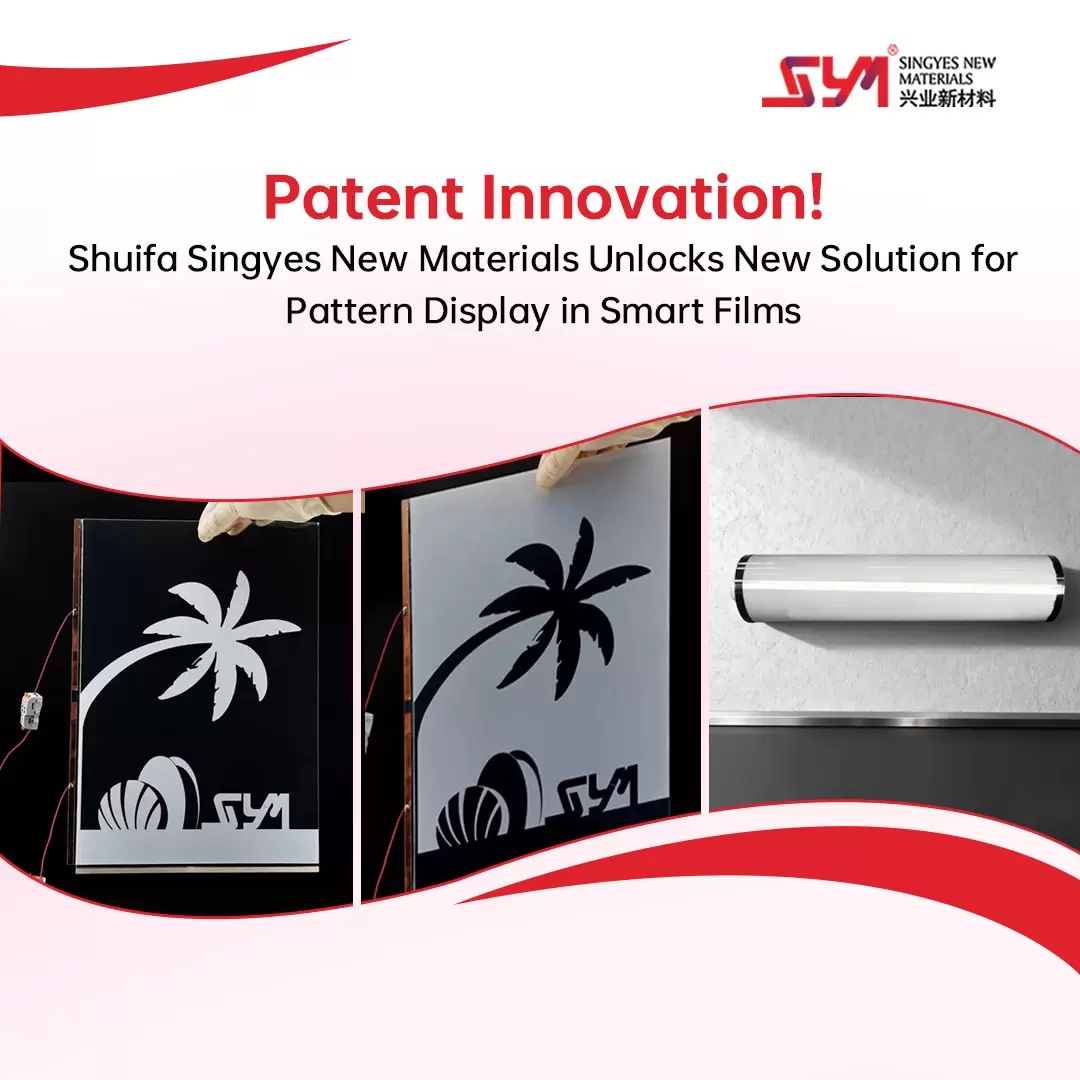
When no voltage is applied, the liquid crystal molecules remain in a randomly oriented state. This causes incoming light to scatter, resulting in a diffused appearance that provides privacy.
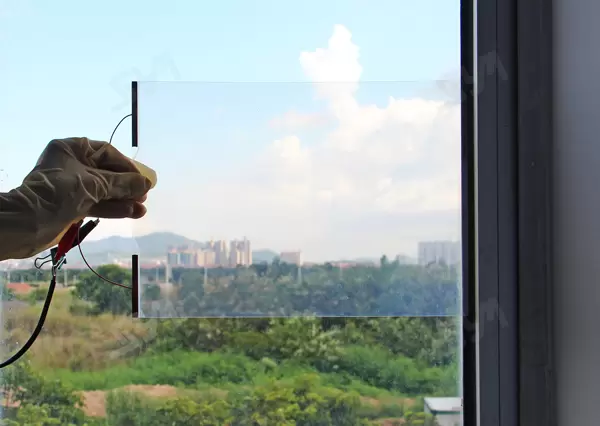
When an electric field is introduced, the molecules align along the direction of the field. This alignment allows light to pass through with minimal scattering, restoring transparency.
From an engineering perspective, this switching process can be described as:
· Electrical excitation → molecular alignment → optical transmission change
This enables real-time modulation of glass transparency without mechanical movement.
In practical applications, this function is referred to as on-demand privacy control, allowing spatial conditions to be adjusted instantly according to operational requirements.
The performance of smart film systems is determined not only by switching capability but also by long-term stability under environmental stress. In architectural applications, materials are continuously exposed to temperature variation, humidity, and ultraviolet radiation.
The laminated structure used in Shuifa Singyes Laminated Smart Film improves structural integrity and environmental resistance, ensuring stable performance over extended service cycles.
Performance Parameter | Functional Outcome |
UV Resistance | Reduces material aging and yellowing |
Thermal Stability | Maintains performance under temperature fluctuation |
Humidity Resistance | Prevents deformation in high-moisture environments |
Optical Uniformity | Ensures consistent transparency and haze distribution |
These characteristics are particularly important in large-scale architectural installations, where long-term reliability directly impacts maintenance cost and system lifespan.
Unlike basic smart film products, laminated structures provide enhanced mechanical protection for the functional layer. This reduces the risk of performance degradation caused by environmental stress or repeated switching cycles.
In industrial and commercial environments, switching frequency can be high. Therefore, operational stability becomes a key evaluation criterion.
Shuifa Singyes Laminated Smart Film is designed to maintain consistent optical performance under continuous operation conditions, ensuring long-term usability in demanding applications.
Modern building systems increasingly rely on centralized control platforms. Glass materials are expected to integrate seamlessly into these digital environments.
The smart film system supports multiple control interfaces, including:
· Mobile application-based operation
· Voice-controlled smart assistants
· Building management system (BMS) integration
This allows transparency states to be adjusted automatically based on predefined conditions such as occupancy, time scheduling, or environmental triggers.
From a system engineering perspective, laminated smart film functions as a controllable optical layer within intelligent architecture systems, rather than an isolated material component.
The adaptability of laminated smart film enables its use across multiple sectors where spatial flexibility is required.
In office environments, glass partitions are widely used to define space while maintaining openness. However, static transparency often limits functional separation.
By integrating smart film systems, partitions can transition between open collaboration zones and private meeting areas without structural modification.
In residential applications, particularly bathrooms and bedrooms, balancing privacy and natural lighting is a key design requirement.
Smart film enables direct control of visibility while maintaining daylight transmission, improving spatial comfort without mechanical shading systems.
Retail and exhibition environments require dynamic visual presentation capabilities. Glass surfaces equipped with smart film can function as transparent display surfaces or projection interfaces, depending on operational requirements.
In large-scale architectural projects, energy control and solar regulation are critical considerations.
Smart film integration into curtain wall systems enables controlled light transmission, contributing to reduced energy consumption and improved indoor environmental stability.
The performance consistency of laminated smart film is directly dependent on manufacturing precision and process stability.
Zhuhai Shuifa Singyes New Materials Technology Co., Ltd. operates a fully integrated production system supported by large-scale manufacturing infrastructure.
The production base includes:
· 40,000㎡ manufacturing workshop
· 20,000㎡ cleanroom environment
The facility is equipped with multiple production lines covering key stages of material processing:
Production Segment | System Configuration | Function |
ITO Film Production | 5 roll-to-roll lines | Conductive layer fabrication |
Wet Coating Process | 3 precision coating lines | Functional layer formation |
Laminating & Slitting | 3 processing lines | Final structure assembly |
This integrated production system ensures process stability from raw material to finished product.
For large-scale architectural and commercial projects, supply stability is a critical requirement. Insufficient production capacity can directly impact project timelines and delivery reliability.
The current production capability includes:
· 4 million m² annual ITO film output
· Over 2 million m² smart film capacity
· 60,000 m² smart glass production capability
This production scale supports continuous supply for high-volume engineering projects while maintaining quality consistency.
One of the key strengths of Shuifa Singyes lies in its vertically integrated manufacturing system.
The complete industrial chain includes:
ITO coating → Smart film production → Smart glass processing → Display system integration
This structure reduces dependency on external suppliers and improves overall process control.
From a manufacturing perspective, integration provides:
· Improved quality consistency
· Shorter production cycles
· Enhanced customization capability
The company operates as the mainland industrial entity of a Hong Kong-listed new materials group and is part of a state-owned enterprise system under Shuifa Group.
This structure provides long-term operational stability and access to industrial resources.
In addition, the company has been recognized as:
· National High-Tech Enterprise
· Specialized and Innovative “Little Giant” Enterprise
· Intellectual Property Advantage Enterprise
· Green Manufacturing Demonstration Unit
These certifications reflect sustained investment in research and industrial development.
In engineering projects involving smart materials, installation accuracy and system integration are as important as product performance.
The company provides technical support covering:
· Project measurement guidance
· Installation process support
· Post-installation technical service
This ensures that system performance is maintained throughout the project lifecycle.
As architectural systems continue to evolve toward higher levels of intelligence and adaptability, traditional static materials are gradually being replaced by functional, controllable systems.
Laminated smart film represents this transition by enabling dynamic control of optical states within glass structures.
Backed by integrated manufacturing capability, large-scale production infrastructure, and strong industrial positioning, Shuifa Singyes Laminated Smart Film serves as a core material in modern intelligent building systems.
It functions not merely as a decorative or functional layer, but as an active component within intelligent spatial environments, supporting the transition toward adaptive, energy-efficient, and user-responsive architecture.