How Smart Film Performs in Different Climate Conditions
Learn more >


Modern homes are using more glass than ever. Floor-to-ceiling windows, glass partitions, open-plan interiors, walk-in bathrooms, home offices, and large bedroom glazing can make a residence feel brighter and more spacious. At the same time, extensive glass introduces a practical question: how can homeowners keep the openness of glass while maintaining privacy when it is needed?
Traditional curtains and blinds remain useful, but they add physical layers to the interior and occupy visual space. Frosted glass provides privacy, but the privacy is permanent. For residential projects where the function of a room may change throughout the day, Smart Film offers another approach.
By controlling the optical state of glass through an electrical signal, PDLC Smart Film can allow a glass surface to switch between a transparent state and a privacy state. This makes it suitable for selected residential windows, interior partitions, bedrooms, bathrooms, home offices, and other areas where privacy and openness need to coexist.
For smart home projects, the value of the technology is not simply the ability to make glass opaque. The more important question is whether the glass can become part of the home's wider lighting, privacy, and space-management system.
Glass has become an important architectural element in contemporary residential design. Large windows bring daylight into rooms and create stronger visual connections with gardens, balconies, city views, and outdoor spaces. Internal glass partitions can separate rooms without making them feel enclosed.
The problem appears when the same room requires privacy.
A home office may benefit from transparent glass during normal family activities but require privacy during a meeting. A bedroom with a glass partition can create a larger visual space during the day, while nighttime use calls for greater separation. A bathroom with extensive glazing presents an even clearer need for privacy control.
Curtains solve some of these situations, but they require a physical movement between open and closed positions. Blinds provide more control but introduce additional components and maintenance requirements. Fixed frosted glass removes the need for curtains but permanently changes the appearance and light transmission of the glass.
Smart Film approaches the problem differently.
Instead of adding a movable covering, the glass itself becomes switchable. When transparency is required, the film can remain in its clear state. When privacy is required, the PDLC layer changes to its privacy state.
For residential designers, this creates more flexibility without requiring a permanent visual barrier.
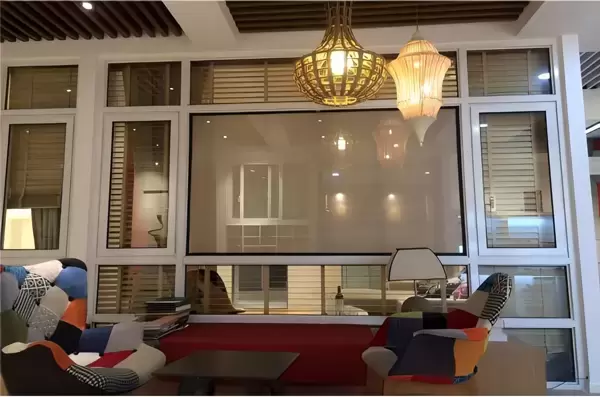
The main residential advantage of Switchable Film is the ability to use the same glass for different purposes at different times.
During the day, transparent glazing can support natural daylight and visual openness. In the evening, privacy mode can reduce visibility through the glass.
This is particularly useful in rooms where the architectural concept depends on openness.
Residential requirement | Traditional solution | Smart Film approach |
Daytime openness | Open curtains or blinds | Transparent film state |
Evening privacy | Curtains or blinds | Privacy film state |
Permanent privacy | Frosted glass | Switchable privacy |
Interior glass partition | Curtains or blinds | Integrated switchable glazing |
Automated privacy | Motorized blinds | Electrical film control |
The difference is not simply appearance. Smart Film changes the way a room can be managed.
A glass partition no longer has to be permanently transparent or permanently private. The same surface can support both conditions.
The growth of home working has changed the requirements for residential interiors.
Many homeowners now use spare bedrooms, studies, living areas, or dedicated glass-enclosed rooms as offices. Designers often prefer glass because it allows daylight to pass through and keeps smaller work areas visually connected with the rest of the home.
Privacy becomes important when the room is being used for meetings or concentrated work.
A Privacy Smart Film system can provide a practical solution. The glass can remain transparent when the office is not in use, maintaining the open character of the home. When a private meeting starts, the glass can be switched to its privacy state.
This arrangement is particularly suitable for:
· Glass office partitions inside large residences
· Home offices connected to living rooms
· Study rooms with internal glazing
· Meeting spaces in luxury residential properties
· Multi-purpose rooms that change function during the day
The benefit is that the partition does not need a curtain track, and the room does not have to look like a conventional office when it is being used as part of the home.
Bedrooms present a different set of requirements.
A bedroom with large windows can provide excellent daylight in the morning, but privacy becomes more important after sunset. Internal glass partitions between bedrooms and dressing areas can create an elegant visual connection, yet permanent transparency may not be suitable for every household.
Smart Window Film allows the same glass to support both conditions.
During daylight hours, the transparent state can preserve natural illumination. When privacy is required, the film can be switched to its privacy state.
The application can also extend to walk-in closets and dressing areas. Instead of installing a solid partition, designers can use glass to maintain a stronger sense of space while retaining control over visibility.
For high-end residential projects, this flexibility can be particularly useful because interior design decisions are often based on maintaining clean lines and reducing unnecessary visual elements.
Bathrooms are another residential area where switchable glazing can make sense.
A glass bathroom partition or internal bathroom window may contribute to the visual quality of a modern residence, but privacy remains essential. Fixed transparent glass is unsuitable for many situations, while permanently frosted glass limits the use of natural light and visual openness.
Smart Film can provide switchable privacy for selected bathroom glazing.
For example, a master bathroom connected to a bedroom may use transparent glass when the room is open and visually connected, then change to a privacy state when the bathroom is occupied.
However, bathroom applications require more attention to the complete glass assembly.
The selection should consider the position of the film, moisture exposure, edge protection, electrical connections, glass construction, and installation conditions. Smart Film should not be treated as a waterproof electrical component simply because it is being used around a bathroom.
For areas exposed directly to water, the complete system needs to be specified and installed according to the application requirements.
A smart home is not defined only by connected lights, thermostats, or security equipment. Interior glass can also become part of the home's control system.
Smart Film can be connected to an appropriate electrical control system, allowing privacy settings to be incorporated into different household routines.
Consider a typical evening.
The homeowner activates a "night" scene. Interior lighting changes, selected curtains close, and designated glass partitions switch to their privacy state. The homeowner does not need to operate every window individually.
A similar approach can be used for other scenes:
Home scene | Possible Smart Film setting | Typical purpose |
Day Mode | Transparent | Natural daylight and openness |
Meeting Mode | Privacy | Home office privacy |
Movie Mode | Privacy | Reduced visual distraction |
Night Mode | Privacy | Bedroom and living-area privacy |
Away Mode | Selected privacy state | Greater visual separation |
The exact control method depends on the electrical architecture and home automation platform used in the project. Compatibility should therefore be confirmed during the design stage rather than assumed.
This is also where Electric Privacy Film becomes more than a simple window treatment. It can form part of a coordinated residential control strategy.
Residential automation can also provide more convenient ways to operate switchable glazing.
Depending on the control system, Smart Film may be connected to:
· Wall-mounted switches
· Remote controls
· Home automation panels
· Timers
· Light sensors
· Occupancy sensors
· Voice-control systems
The purpose is not to add automation for its own sake. The control method should correspond to the actual use of the room.
A bathroom may benefit from automatic privacy control based on occupancy. A home office may use a dedicated wall switch or scene setting. A bedroom may be linked to a nighttime routine.
This makes the selection of the control architecture just as important as the film itself in a larger smart home project.
There is no universal replacement for curtains, blinds, or frosted glass. Each solution has its own place in residential design.
Curtains remain useful where complete blackout, decorative treatment, or strong solar shading is required. Motorized blinds can provide precise shading and daylight control. Frosted glass remains a straightforward option when permanent privacy is acceptable.
Smart Film becomes more attractive when the project requires switchable privacy.
The distinction can be summarized simply:
Curtains provide physical coverage.
Frosted glass provides permanent diffusion.
Smart Film provides electronically controlled privacy.
This difference matters when a room needs to serve more than one purpose.
A glass partition that is permanently frosted cannot become completely transparent when the homeowner wants visual openness. A curtain can open and close, but it remains a physical element within the room. Smart Film keeps the glass surface visually clean while allowing its optical state to change.
Energy performance deserves a careful explanation.
Smart Film can contribute to better control of daylight and glare, but it should not be presented as a substitute for high-performance architectural glazing.
The overall thermal performance of a residential window depends on the complete system, including:
· Glass type
· Low-E coating
· Window frame
· Solar orientation
· Local climate
· Shading design
· HVAC system
· Film optical characteristics
The primary function of PDLC Smart Film is privacy and visible-light management.
In a residence with extensive glazing, maintaining appropriate daylight can reduce the need for artificial lighting during some periods. Managing excessive glare can also improve comfort around windows and workspaces.
However, the film should be considered as one component of the building envelope rather than the sole energy-saving measure.
For projects in hot climates, the glass specification, solar-control strategy, external shading, and HVAC design remain critical. Smart Film can complement these measures, but it does not replace them.
The practical value of Smart Film varies according to the architecture of the property.
Large windows and extensive interior glazing are common in high-end villas. Smart Film can be considered for bedroom glazing, bathroom partitions, home offices, and selected living-area windows where privacy changes throughout the day.
Space efficiency is often more important in apartments. Glass partitions can divide a limited floor area without making rooms feel smaller. Smart Film allows the partition to provide privacy when needed while retaining visual openness at other times.
Open-plan residential layouts can be visually impressive but may have limited private areas. Switchable glass partitions can create temporary separation without permanently breaking the connection between spaces.
For homes with integrated automation, Smart Film can be included within scene-based control. Privacy settings can be coordinated with lighting, security, and other residential systems where the control architecture allows it.
Existing glass does not automatically need to be replaced. Self Adhesive Smart Film may provide an option for upgrading selected glass surfaces, subject to glass condition, dimensions, surface quality, installation environment, and electrical requirements.
For renovation projects, replacing an entire glass panel can involve considerable work.
A self-adhesive format can make Smart Film relevant to selected retrofit applications because it can be applied to an existing glass surface when the substrate and installation conditions are suitable.
This can be useful for:
· Existing home offices
· Glass meeting rooms in private residences
· Bedroom partitions
· Selected interior windows
· Decorative glass partitions
· Renovated bathrooms with suitable glazing
The suitability of retrofit installation depends heavily on the existing glass. Surface contamination, scratches, unevenness, moisture, dimensions, wiring access, and edge conditions should be checked before the material is specified.
The installation environment also matters. Film application requires a clean and controlled glass surface, while the electrical connection and edge protection need to be planned as part of the finished system.
For larger residential projects, early coordination between the architect, glass contractor, electrical contractor, and Smart Film supplier can prevent avoidable installation problems.
New construction provides more options because the glass system can be planned from the beginning.
Laminated Smart Film can be incorporated into laminated glass assemblies where the project specification, glass construction, and manufacturing process are suitable.
This approach can provide a more integrated appearance because the switchable layer becomes part of the glazing assembly rather than being added later to an existing surface.
For architects and residential developers, early specification also allows several factors to be coordinated:
· Glass thickness
· Laminated structure
· Film dimensions
· Electrical routing
· Edge treatment
· Control system
· Frame details
· Installation sequence
This is particularly important for large custom residential projects where the glazing dimensions may be substantial and replacement after installation can be expensive.
The right product depends on the glass and the room rather than simply the appearance of the film.
Before specifying Smart Glass Film or another PDLC solution, several practical questions should be considered.
For retrofit applications, the existing glass should be clean, smooth, structurally sound, and suitable for film application.
Interior installation is generally easier to manage because the film is protected from direct exposure to rain, snow, dust, and physical impact. Exterior applications require a different level of system consideration.
Smart Film requires electrical connections and a suitable power-control arrangement. Wiring should be incorporated into the design rather than added as an afterthought.
Bathrooms and other humid areas require careful attention to edge protection and electrical safety.
Large glass panels require accurate measurements and appropriate product selection. Oversized areas may also require more careful electrical planning.
The finished surface should be cleaned according to the film manufacturer's recommendations. Abrasive tools, aggressive chemicals, and methods that could damage the film surface should be avoided.
These points are especially important for residential projects where replacing a finished glass panel can disrupt interior finishes.
The strongest argument for Smart Film in residential design is its ability to change the function of a glass surface.
A home office can remain visually open when not in use and become private during a meeting.
A bedroom can maintain a sense of space during the day and provide stronger separation at night.
A suitable bathroom partition can allow visual openness while still offering privacy when required.
A living area can remain bright without permanently exposing interior activities to surrounding spaces.
This flexibility is particularly valuable in modern homes where one room often serves several purposes.
The same principle applies to Smart Film for Buildings on a smaller residential scale: glass is no longer treated as a fixed architectural surface with one permanent optical condition. Its function can be adjusted according to how the space is being used.
Not every window needs switchable technology.
For ordinary bedroom windows that already have effective curtains or blinds, the additional complexity may not be justified. Large areas of exterior glazing may also require a complete solar-control strategy beyond what PDLC Film provides.
The strongest applications are usually locations where privacy changes frequently and where maintaining a clean glass appearance has architectural value.
These can include:
1. Home offices requiring temporary privacy during meetings.
2. Glass bedroom and dressing-area partitions.
3. Selected bathroom glazing where privacy changes according to occupancy.
4. Open-plan living spaces requiring flexible visual separation.
5. High-end residential interiors where traditional curtains would interfere with the intended design.
6. Smart home projects where glass needs to participate in automated room scenes.
This approach keeps the technology focused on areas where it delivers a clear functional benefit.
Smart homes are increasingly defined by how different building elements work together. Lighting, security, climate control, shading, and room access can all respond to changing household requirements.
Glass can be part of the same system.
Switchable Smart Film provides a relatively direct way to give selected glass surfaces an additional function without turning every window into a complicated mechanical system.
For architects, the appeal lies in design flexibility.
For homeowners, it lies in convenience and privacy.
For developers, it can provide a differentiated feature for premium residential projects.
For renovation projects, self-adhesive formats can create possibilities where complete glass replacement is not practical.
The important point is to select the technology according to the room, glazing construction, climate, electrical system, and expected usage rather than treating Smart Film as a universal replacement for conventional window treatments.
Modern residential architecture has created a stronger demand for glass, but more glass also means more situations where privacy needs to be managed.
PDLC Smart Film provides a practical response by allowing selected glass surfaces to change between transparent and privacy states. Its strongest residential applications are not based on replacing every curtain or window treatment. They are based on solving specific situations where a fixed glass surface needs to perform more than one function.
Home offices can switch between openness and privacy. Bedrooms can retain daylight while gaining greater separation at night. Suitable bathroom partitions can combine visual openness with controlled privacy. Open-plan interiors can be divided temporarily without introducing bulky physical barriers.
When connected with an appropriate residential control system, Smart Film can also become part of wider home scenes involving lighting, occupancy, and daily routines.
For new construction, laminated solutions can be considered during the glazing design stage. For selected renovation projects, Self Adhesive Smart Film can provide a retrofit option when the existing glass and installation conditions are suitable.
The result is not simply a darker window or a replacement for curtains. It is a more flexible approach to residential glazing, where privacy, daylight, interior appearance, and room functionality can be adjusted according to the needs of the people using the space.