Custom PDLC Film Producer: Automotive Smart Film Built Around Real Driving Needs
Learn more >


Conventional automotive glazing systems have long relied on fixed-function solutions such as tinted glass, adhesive window films, and mechanical sunshades to manage privacy and solar control. While these approaches provide partial benefits, they introduce clear limitations in dynamic driving environments. Fixed tint levels cannot adapt to changing light conditions, laminated films degrade over time under UV exposure, and mechanical shading systems add weight, mechanical complexity, and inconsistent user experience.
As vehicle interiors evolve toward intelligent, software-defined environments, the demand for dynamic optical control has increased significantly. Automotive OEMs and smart cockpit integrators are now seeking solutions that can actively switch between transparency and privacy states without mechanical movement or optical compromise. This requirement has accelerated the adoption of electro-optical technologies, particularly PDLC-based systems.
Among these, car PDLC smart film has emerged as a key enabling material for switchable privacy glass systems in automotive platforms. By enabling electrically controlled modulation of light transmission, it provides a controllable optical layer that integrates directly into vehicle glazing architectures. For OEM procurement teams and system integrators, the focus is no longer only on visual performance, but on response speed, durability, electrical compatibility, and manufacturing consistency at scale.
In this context, selecting a qualified car PDLC smart film manufacturer becomes a critical decision factor that directly impacts product stability, vehicle system integration, and long-term reliability.
Car PDLC smart film (Polymer Dispersed Liquid Crystal film) operates through a controlled electro-optical mechanism in which liquid crystal droplets are dispersed within a polymer matrix. The optical state of the film is determined by the alignment behavior of these liquid crystal molecules under an applied electric field.
In the off-state (no voltage applied), liquid crystal molecules remain randomly oriented. This causes incident light to scatter as it passes through the film, resulting in a translucent or frosted appearance. In this state, external visibility is blocked while diffused light transmission is maintained.
In the on-state (electric field applied), the liquid crystal molecules align along the direction of the electric field. This alignment reduces light scattering and allows light to pass through more directly, resulting in a transparent optical state.
The switching behavior can be summarized in the following operational logic:
· Voltage OFF → Random molecular orientation → High haze / privacy mode
· Voltage ON → Aligned molecular orientation → High transparency mode
This electro-optical transition is not mechanical and does not rely on physical movement, which is a key differentiator from traditional shading systems.
Parameter | Function in Automotive Use | Engineering Impact |
Switching Mechanism | Electric field-driven molecular alignment | No mechanical wear |
Response Behavior | Millisecond-level optical transition | Real-time privacy control |
Optical State Control | Adjustable haze and transmittance | Multi-mode driving scenarios |
Structural Composition | Polymer + liquid crystal dispersion | Flexible lamination integration |
Unlike conventional automotive tint films, which are static and permanently alter light transmission, car PDLC smart film provides dynamic optical modulation. This allows a single glazing system to serve multiple functional states without physical modification.
From an engineering perspective, the key distinction lies in control architecture. Traditional films operate as passive materials, while PDLC systems function as active optical components integrated into vehicle electrical systems.
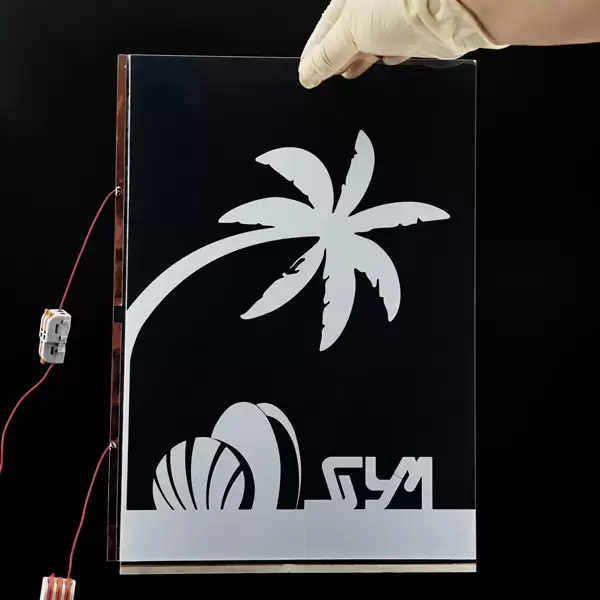
The integration of car PDLC smart film into automotive platforms is primarily driven by the evolution of smart cockpit architectures. Modern vehicles increasingly rely on zoned interior environments where lighting, privacy, and visibility must be dynamically controlled through electronic systems.
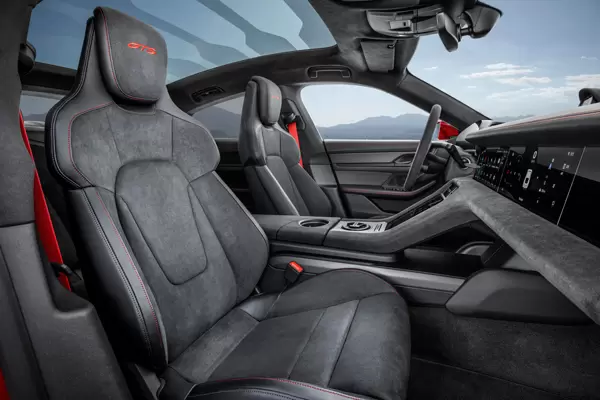
In panoramic and standard sunroof applications, PDLC smart film is laminated between glass layers to enable dynamic light modulation. This eliminates the need for mechanical sunshades or perforated roller systems.
Typical use behavior includes:
· Transparent mode during night driving or open visibility preference
· Translucent mode under high solar radiation conditions
· Automatic switching via ambient light sensors
The elimination of mechanical shading components also reduces system weight and improves long-term reliability.
Side windows and rear cabin partitions are key application areas where privacy control is critical. In premium vehicles and executive transport configurations, PDLC film enables instant transition between open visibility and full privacy states.
Typical operational modes include:
· Driving mode (high transparency for visibility and safety)
· Parking mode (privacy activation)
· Executive mode (rear cabin isolation)
In advanced automotive architectures, car PDLC smart film is not operated as a standalone component but as part of a centralized control ecosystem. Integration pathways typically include:
· Vehicle body control module (BCM)
· Infotainment system interface
· Voice command activation
· Predefined scenario switching (e.g., “privacy mode”, “cinema mode”)
This transforms PDLC film into a programmable optical interface rather than a static material layer.
Automotive PDLC systems are typically configured around usage scenarios rather than manual control:
· Driving scenario → Maximum visibility priority
· Parking scenario → Privacy and heat reduction
· Business scenario → Rear cabin isolation
· Entertainment scenario → Light diffusion control for display optimization
This scenario-based logic is a key requirement for OEM integration.
The performance of car PDLC smart film in automotive environments is defined by measurable optical, electrical, and durability parameters rather than subjective visual perception.
Performance Parameter | Typical Range | Automotive Relevance |
Switching Time | 10–100 ms | Real-time response for cockpit control |
Haze Level | ≥95% (privacy state) | Effective visual isolation |
UV Blocking Rate | >99% | Interior material protection |
Operating Voltage | Low-voltage AC | Vehicle electrical compatibility |
Service Life | 8–10 years | OEM lifecycle requirement |
The value of PDLC systems becomes most evident under dynamic environmental conditions rather than static laboratory testing.
In high solar exposure environments, the film can transition into diffusion mode to reduce glare without fully blocking ambient light. During nighttime driving, the system returns to high transparency mode to maintain maximum visibility. This dual-state adaptability is a key reason for its increasing adoption in premium automotive platforms.
From an electrical perspective, modern car PDLC smart film systems are designed for low-power consumption, allowing integration into vehicle power architectures without significant load impact.
Unlike mechanical shading systems, PDLC films also eliminate moving parts, reducing long-term failure risk and maintenance requirements.
In automotive applications, product performance alone does not determine system success. Manufacturing capability, optical consistency, and production scalability are equally critical. This is where the role of a qualified car PDLC smart film manufacturer becomes decisive.
A high-level manufacturer must ensure not only material performance but also industrial-scale reproducibility.
· Optical Uniformity Control: Ensures consistent haze and transparency across large-area films without visible banding or distortion
· Roll-to-Roll Precision Coating: Enables continuous production of large-format optical films with stable layer thickness
· Automotive-Grade Reliability Testing: Includes UV aging, temperature cycling, humidity resistance, and vibration simulation
· Dimensional Customization Capability: Supports OEM-specific window geometries and integration requirements
· Production Scalability: Maintains consistent output quality across high-volume automotive supply chains
Capability Dimension | Standard Supplier | Professional Manufacturer |
Optical Consistency | Medium batch variation | High uniformity control |
Production Scale | Limited volume | Industrial-scale output |
Automotive Testing | Basic validation | Full environmental simulation |
Customization Ability | Restricted formats | OEM-specific design support |
Supply Chain Stability | Variable delivery | Structured long-term supply |
A mature car PDLC smart film manufacturer typically operates integrated production systems combining ITO film deposition, precision wet coating, and lamination processes. This vertical integration directly impacts product stability and delivery consistency.
In advanced manufacturing setups such as those used by leading material companies, production systems often include:
· Large-area cleanroom environments for optical film fabrication
· Roll-to-roll ITO conductive film production lines
· Precision wet-coating lines for PDLC layer formation
· Laminating and slitting systems for automotive-grade processing
Such infrastructure ensures that optical performance is not only achieved in prototype stages but maintained consistently in mass production.
For automotive OEM procurement teams, this manufacturing depth is often a determining factor when selecting long-term suppliers.
The automotive industry is transitioning toward intelligent, software-defined interior environments where optical control becomes an active system function rather than a passive material property. Within this shift, car PDLC smart film represents a foundational technology for switchable privacy glass and adaptive glazing systems.
Its ability to dynamically transition between transparency and diffusion states without mechanical components positions it as a key enabling material for next-generation smart vehicles.
However, the long-term success of PDLC integration depends not only on material performance but also on manufacturing precision, optical consistency, and scalable production capability. This makes the role of a professional car PDLC smart film manufacturer central to OEM adoption strategies.
As vehicle architectures continue to evolve, PDLC-based optical systems are expected to become a standard component in smart cockpit design, supporting both functional adaptability and system-level integration across automotive platforms.