Switchable PDLC Film for Offices: Turning Glass Walls into Flexible Space
Learn more >


For a large glass curtain wall, transparency is rarely the difficult part. The harder question is what happens when the building no longer needs transparency.
A public building may look completely different from one hour to the next. An airport terminal needs visual openness and daylight across passenger areas, while offices and meeting spaces within the same glazed envelope may require privacy. An exhibition hall may need a clear facade during normal operation and a more controlled visual environment during presentations. Civic buildings face a similar conflict between public visibility and private working areas.
Traditional glass remains in one optical state. Curtains, blinds, louvers, and other shading systems can provide additional control, but they also introduce hardware, maintenance requirements, and restrictions on the original facade design.
PDLC Smart Glass takes a different route by making the glazing itself controllable.
That does not mean smart glass should replace every shading or solar-control measure in a building. Its real value appears where transparency and privacy are both required, but not at the same time.
A curtain wall is designed as a complete building envelope. Glass, framing, structural connections, insulation, drainage, sealing, and other components all have to work together.
Adding switchable glass therefore cannot be treated as simply replacing conventional glass with a product that can turn opaque.
The specification has to answer several practical questions:
· Which areas need switching?
· What should remain transparent?
· How large should each control zone be?
· What glass structure is appropriate?
· Where will the electrical connections be located?
· How will the system be inspected and maintained?
Those decisions are particularly important when the glazing area reaches hundreds or thousands of square meters.
For a small interior partition, changing the glass state may be a relatively simple matter. A large curtain wall is different. Glass dimensions, mullion positions, electrode layout, wiring routes, power supply, and control zones become part of the facade design.
That is where Smart Glass becomes an architectural engineering product rather than simply a privacy film.
There is sometimes a tendency to describe switchable glazing mainly from the privacy side. For curtain walls, that misses half of the reason architects use glass in the first place.
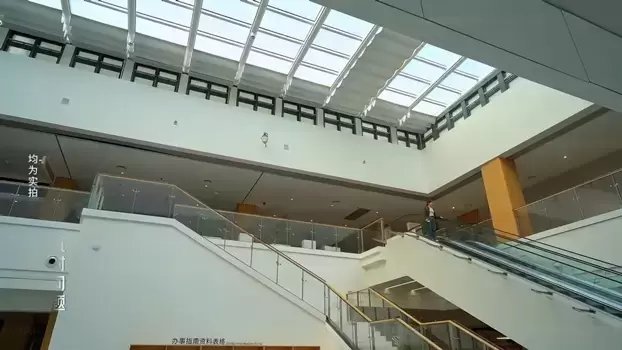
Transparent glazing brings daylight deep into public spaces and maintains visual contact with the exterior. It can also contribute to the openness that defines the appearance of many contemporary buildings.
PDLC Smart Glass preserves that transparent operating state when privacy is not required.
The building therefore does not need to remain visually closed simply because certain rooms occasionally need privacy.
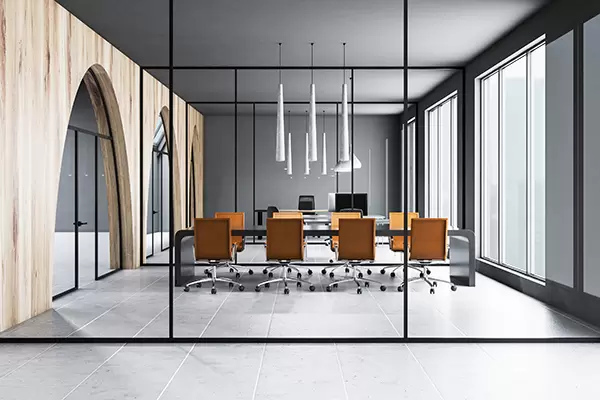
Take a meeting room located directly behind a glazed facade. During normal circulation or reception activities, transparency may be desirable. Once a confidential meeting begins, clear glazing becomes a disadvantage. With switchable glass, the same panel can move to a frosted state without installing a curtain across the facade.
That change in operating condition is the main reason to consider PDLC for curtain wall applications.
A common mistake in large projects is to think of the curtain wall as one uniform surface.
Buildings rarely operate that way.
Different rooms have different functions, different occupancy patterns, and different privacy requirements. A public lobby may need to stay transparent throughout the day. A conference room may require privacy for only a few hours. An administrative office may have another operating schedule.
Electrical zoning allows those areas to be treated separately.
Building Area | Typical Requirement | Suitable Control Approach |
Public lobby | High transparency | Transparent operation |
Meeting room | Temporary privacy | Independent switching zone |
Administrative office | Controlled visibility | Local or centralized control |
Exhibition area | Flexible visual environment | Zone-based control |
Restricted area | Higher privacy requirement | Dedicated control zone |
For large curtain walls, zoning should be decided together with the architectural layout rather than added after the glass has already been ordered.
A poorly planned control zone can create unnecessary switching of adjacent areas, complicated wiring, and inconvenient maintenance.
Good zoning does the opposite: it makes the glass behave according to how the building is actually occupied.
Another point deserves attention during specification.
PDLC Smart Glass is primarily valuable for privacy and visual control. It should not automatically be treated as a substitute for external solar shading, Low-E glass, or other building-envelope measures.
A west-facing facade exposed to strong afternoon sun presents a different problem from an interior meeting room that simply needs privacy.
Solar radiation, facade orientation, glazing ratio, local climate, glass construction, interior finishes, and occupant positions all influence thermal and visual comfort.
For that reason, a project may combine several technologies:
High-performance glazing + appropriate facade design + external shading where required + PDLC Smart Glass for controllable privacy
The combination is often more technically sound than asking one product to solve every facade problem.
The PDLC layer is only one part of the final smart glass assembly.
For architectural curtain walls, the surrounding glass structure has to be selected according to the building's requirements.
Laminated construction can be considered where safety, structural requirements, or special-shaped glazing are important. It is also useful when the project involves customized glass geometry.
Where thermal and acoustic performance are significant, an insulated configuration may be more appropriate.
Some projects require several functions to be addressed within the same glazing assembly. Composite smart glass configurations can be developed around those requirements.
There is no single glass structure that fits every curtain wall.
A specification developed from the building envelope first will normally be more reliable than selecting the glass model first and trying to adapt the facade afterward.
Visible light transmittance and haze are often listed as product parameters, but numbers alone do not determine whether a glazing specification is appropriate.
A highly transparent public facade has different requirements from a meeting room or an exhibition space.
The design team should consider:
· How much daylight the space needs.
· Whether exterior views are important.
· How the glass will be used in transparent operation.
· How much visual diffusion is required in privacy mode.
· Whether strong daylight creates glare at specific viewing positions.
Optical specifications should therefore be tied to the room function and facade position.
That is particularly important when one project contains several different types of spaces.
Size becomes a serious issue as soon as a project moves beyond standard interior glazing.
Large public buildings often contain oversized panels, curved sections, skylights, domes, and other non-standard glass forms. Electrical connections have to fit within the glass and curtain wall geometry without compromising the intended appearance.
Several details need to be settled before production:
Item | Engineering Concern |
Glass dimensions | Fabrication limits and installation tolerance |
Electrode position | Connection and control reliability |
Control zones | Building function and operating requirements |
Cable routing | Concealment and maintenance access |
Power supply | Safe and stable operation |
Maintenance access | Inspection and future service |
For irregular or large-width glass, early engineering coordination is particularly important.
Changing the panel dimensions late in the project can affect electrode locations, cable lengths, mullion arrangements, and control zoning at the same time.
PDLC glass requires electrical control, so electrical planning should begin at the same stage as the glass specification.
Low-voltage power supply is generally used for the smart glass system, while the project control architecture can vary according to the building.
A simple installation may use local switches. A larger building may require centralized control or integration with a broader building automation system.
Regardless of control method, the design should define:
power supply → control zones → electrode connections → glass panels
That chain needs to be checked before fabrication.
For maintenance, connection points should remain accessible even when the visible wiring is concealed. Hiding every component without considering future inspection can create unnecessary problems for facility management.
Large smart curtain wall projects involve more than assembling glass.
The quality of the final product depends on several upstream processes, including the conductive layer, PDLC material, film production, cutting, electrode processing, and glass lamination.
Zhuhai Shuifa Singyes New Materials Technology Co., Ltd. has an integrated manufacturing chain covering:
ITO film production → PDLC formulation development → PDLC film production → cut-to-size processing → glass lamination
Vertical integration can be particularly useful for customized architectural projects because changes in glass dimensions, film specifications, electrode arrangements, and final assembly can be coordinated within one production system.
For a small standard order, that capability may not be the deciding factor.
For a 2,000㎡ or 7,000㎡ project with customized dimensions and multiple control zones, it becomes much more relevant.
The application of smart glass becomes more convincing when viewed through completed building projects rather than product descriptions alone.
At Guiyang Longdongbao Airport T3, approximately 7,000 square meters of smart glass external curtain wall were supplied as part of a large-scale project.
Hengqin Civic Center used approximately 2,000 square meters of customized composite smart glass for its lighting roof.
At Ningbo Tongshan Future Community Exhibition Hall, approximately 2,300 square meters of customized smart glass were supplied.
Shanxi Datong Energy Museum incorporated approximately 2,500 square meters of smart glass together with more than 230,000 lighting points.
The four projects have very different architectural functions. That difference is important.
It shows that the value of Smart Glass is not tied to one particular building type. The common requirement is the need to combine large glazed surfaces with controllable visual conditions.
Smart Glass is not automatically the best choice for every glass facade.
A conventional high-performance glazing system may be sufficient when the facade only needs daylight, thermal performance, and fixed transparency.
PDLC becomes more interesting when the project has a genuine need for changing visual conditions.
Several questions can help determine whether the technology is justified:
1. Does the same glazed area need both transparency and privacy?
2. Will privacy requirements change according to occupancy or time?
3. Would curtains or blinds interfere with the intended architectural appearance?
4. Does the project require independent control of different glazing areas?
5. Can electrical connections and control zones be incorporated during facade design?
6. Are customized glass dimensions or special shapes required?
If the answer to several of these questions is yes, switchable glazing deserves consideration during the early design stage.
The strongest curtain wall projects do not treat Smart Glass as an electronic accessory added to finished architecture.
Glass structure, optical performance, electrode design, control zoning, dimensions, power supply, installation, and maintenance should all be considered together.
That is also why the early design stage matters so much.
Once the curtain wall drawings are fixed, changing glass dimensions or electrical arrangements can become expensive. When smart glazing requirements are established early, the supplier can coordinate the glass construction and control system around the actual building.
For large public buildings, the goal is not simply to make glass switch from clear to frosted.
The real objective is to give the facade a controllable visual function without losing the architectural advantages of glass.
That is what makes PDLC Smart Glass worth considering for modern building curtain walls.